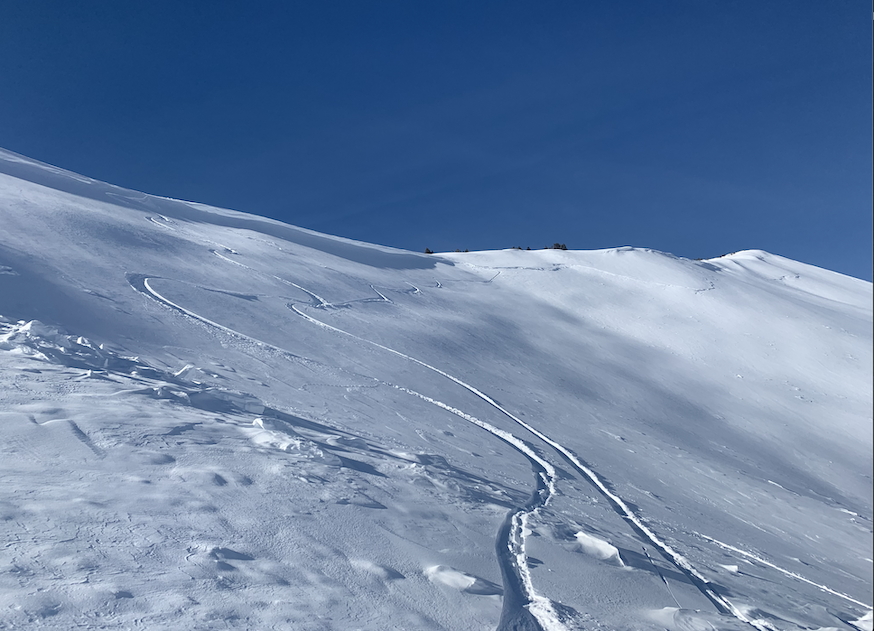
Swiss cheese?

CB Avalanche Center2020-21 Observations

Date of Observation: 01/12/2021
Zone: Northwest Mountains
Location: Cool place
Aspect: North, North East
Elevation: 10,000-12,000

Avalanches: None
Weather: sunny, warm up high, calm
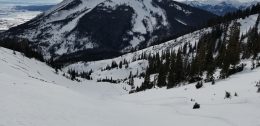
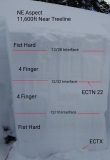
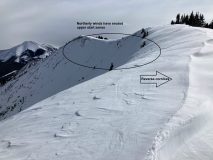
Snowpack: I don’t speak freaky deaky snow science but I do know this. The snowpack heading up to the ridge on a NE aspect was encouraging where it was deeper (120 cm) with a pretty stout “midpack.” Less encouraging when it got shallower and not so encouraging “midpack” (more like “midpunch”) due north 11,50-10,500 in areas that had not seen the sun. Like pole punchy with a smidge of resistance about 10 inches down and then no resistance to the ground. By the final pitch it was a facetfest. Swiss cheese? Spatial variability?

Photos:

Snodgrass Obs

CB Avalanche Center2020-21 Observations

Date of Observation: 01/12/2021
Name: Alex Tiberio

Zone: Southeast Mountains
Location: NE side of snodgrass
Aspect: North, North East, East
Elevation: 10,500

Avalanches: Easy to trigger dry loose avalanches in steep terrain

Snowpack: Seems as though everywhere we traveled the slab had faceted away. The one formal pit we dug at 10,600 produced ECTN results

Purple Ridge obs

CBAC2020-21 Observations

Date of Observation: 01/11/2021
Name: Eric Murrow & Zach Kinler


Zone: Northwest Mountains
Location: Purple Ridge standard up track area
Aspect: North East, East, South East
Elevation: 9,600′ – 11,600′


Avalanches: nothing new to report
Weather: clear skies, nasty cold at valley bottom along the slate gave way to pleasant conditions just a few hundred feet above valley bottom and above. Very light winds near ridgetop with no drifting snow observed.
Snowpack: Ascended generally easterly terrain to ridgetop. This is a snow favored area around Crested Butte with the deepest snow accumulations in the forecast area. No signs of instability noted like collapsing or cracking. Very little traffic in this area since the 12/29 storm. Near treeline probing revealed a snowpack around about 120cm or so deep with a very dense slab resting on top of the basal weak layer. See profile for a look at the snowpack in sheltered terrain in this area. The slab is dense, up to pencil hard BUT the weak layer remains uninspiring with minimal signs of improvement like rounding or increased hardness. Stability tests only confirmed the stubborn nature of human triggered avalanches, you would need to find a thinner spot in the slab to get a result, but if you did, sure would be an ugly avalanche.

Went to have a look at the large, natural avalanche from 12/29 on Purple Ridge to test adjacent slopes and identify how deeply it failed. Probing through part of the bed surface revealed that this avalanche failed very near the ground. Even with 20cm of refilled snow on the bed surface, the snowpack was generally only 30 to 50 cms deep in total. Tests adjacent to this slide produced an ECTP 16 on the same interface just 20 to 30cm above the ground. Probing hangfire showed 150 – 200cm right below ridgetop quickly tapering to 130cm-ish 30 to 50 feet below ridgetop. The slab in this drifted area was mostly pencil hard helping to insulate the weak layer from the weight of a person, but I was surprised at how poor the weak layer continues to look (4finger hard) and I still remain uninspired to test the waters on big, drifted terrain features. Definitely stubborn to trigger but not confidence-building assessments. Bed surface of this previous avalanche path consists of lower density, small-grained facets sitting on a slick, crusty bed surface….a recipe for certain avalanches once it is reloaded by a significant storm.

Photos:


Shooting crack in the Slate

CBAC2020-21 Observations

Date of Observation: 01/11/2021
Name: Zach Guy

Zone: Northwest Mountains
Location: Schuylkill Ridge
Aspect: North East, East
Elevation: N/BTL

Avalanches: Minor sluffing
Weather: Strong inversion. Mostly clear skies. Calm winds.
Snowpack: Rec skiing – traveled on mostly existing skin tracks or terrain that avalanched in mid-December and saw no signs of instability until reaching flat terrain at valley bottom, where we got one large collapse that produced a shooting crack 150′ long. Widespread weak layers on the surface: surface hoar decreases in size and distribution at higher elevations. Near surface facets are widespread. The snowpack in terrain that avalanched earlier in December is noticeably weaker (often trapdoor skiing on larger grained, fist hard facets) and is set up to be a repeat offender whenever we get another slab-forming event.


Photos:

Carbon north side

CBAC2020-21 Observations

Date of Observation: 01/10/2021
Name: Eric Murrow


Zone: Southeast Mountains
Location: North “bowl” on carbon peak
Aspect: North, North East, North West
Elevation: 10,000′ – 12,000′


Avalanches: skier-triggered loose avalanche in surface snow on a very short, roll-over. The steep slope was short so only entrained the top few inches.
Weather: Mostly clear day with cool air temperatures. Light winds at 12,000′, no transport observed.
Snowpack: Traveled through northerly slopes only. Produced one collapse around 10,400′ that rolled maybe 100ish feet – dug profile nearby to have a look/test, see photos. Produced a few other small collapses below treeline but fairly localized, ~30 foot radius. Ski pen was surprisingly good at 6″ – so trail breaking was pleasant. As we ascended to near treeline the snowpack felt similar, just a bit deeper – slab never felt more than 4f finger hardness (did not travel through drifted features). Walked through a variety of meadows above 11K with little or no traffic this winter and stomped hard looking for a collapse but nada even though pole probing indicated the obvious weak snow at bottom of snowpack. Skied slopes in the low 30-degree range but actively avoided nearby steeper features in the near treeline elevation band without any signs of instability. While descending, experienced a couple of spots with “trap-door” conditions where we sunk deeply into the snowpack even near treeline where snowpack depth decreased to less than 70cms. It is clear that the slab continues to lose strength due to faceting, but there are still a few places/features that can produce a smaller Persistent Slab avalanche below treeline but those places are becoming harder to find.

Photos:


Large slide on Bellview

CB Avalanche Center2020-21 Observations

Date of Observation: 01/10/2021
Name: Zach Guy

Zone: Northwest Mountains
Location: Mt. Bellview
Aspect: South East
Elevation: ATL

Avalanches: Large slab avalanche on the SE face of Bellview noted yesterday. We suspect this ran naturally during the windloading on 1/6.  Let us know if you have other information on the timing or trigger.

Photos:

Loose Dry, Again…

CB Avalanche Center2020-21 Observations

Date of Observation: 01/10/2021
Name: Emilio Alcala


Zone: Southeast Mountains
Location: Gunsight Pass Rd, below Wolverine
Aspect: North East
Elevation: 10,026


Avalanches: Loose Dry Sluff on NE slope 38 deg.
Weather: Partly Sunny, Calm
Snowpack:


Photos:

Stay Snoddy

CB Avalanche Center2020-21 Observations

Date of Observation: 01/09/2021
Name: Chris Martin


Zone: Southeast Mountains
Location: Snodgrass/Gothic Road
Aspect: North, North East, East
Elevation: 9000′-10000′


Avalanches: Continue to hear localized whumps in undisturbed snow where slabs remain stiff.
Weather: Partly Cloudy, warm, Sunny, no winds, Cold end to the day below Gothic road around the northern captures of the compass.
Snowpack: Toured from East onto the N-NE portion of the compass, BTL. Observed slabs decomposing into softer snow. Where we dug, we still observe a F-1F slab structure, that 1F portion has shrunk with time, slowly becoming softer from the top down. From last weekend to now, we are no longer seeing propagating test results in this location. Where slabs remain stiff in isolated terrain, localized whumpfs continue to be experienced.

HS 80cm Snodgrass 9800′

48 cm 1F-F Slab that is deteriorating
-over- (DEC 10th PWL 2-3mm FC)
32cm FC/DH 2-3mm

No propagating test results on DEC 10th Layer
CTMSC 48cm down (Dec 10th PWL)


Mt Axtell

CBAC2020-21 Observations

Date of Observation: 01/09/2021
Name: Jared Berman & Jack Caprio

Zone: Northwest Mountains
Location: From Splains Gulch ascended the West face to the summit of Axtell. Skied South facing bowl before traveling back up S/SW ridge where we then skied the West face of Axtell back down to sleds
Aspect: North East, East, South-West, West
Elevation: 10,100ft – 12,500ft

Avalanches: None observed.

Weather: Broken clouds throughout the day and light winds from the NE. Several short periods of very light snowfall accumulating only trace amounts near and above treeline.

Snowpack:

The snowpack is still showing clear signs of instability on many aspects. However, collapsing and shooting cracks are only happening on specific terrain features and have started to become more stubborn.  Slabs are slowly faceting away but there are still many areas that hold a dangerous persistent slab structure.

While ascending a westerly aspect below treeline, we felt periodic collapsing in open meadows where we found soft slabs resting on top of depth hoar (12/10 interface). These collapses were almost always initiated by the third skier. HS on west aspects is shallow near and below treeline averaging about 75cm.

Near treeline on a SW aspect produced collapsing as well. One snowpit at this elevation/ aspect showed a 4F slab resting on top of Fist hard weak faceted snow. An Extended Column Test produced at ECTN21 at this location.

Moving around the compass to NE aspects we continued to experience several occasions of collapsing near and above treeline. Recent northerly winds did a number on start zones of the NE facing bowls of Axtell. These winds have created thin snow cover just below ridgetops that will surely weaken and become a problem at our next significant loading event.

We spent little time on east aspects, but experienced the most exciting results in these areas. A large collapse was observed with shooting cracks that ran about 30ft on a small East facing convexity at 10,000′. A snowpit dug adjacent to the collapse yielded our only propagating results of the day (ECTP 14). These failures were initiated on a thin MF crust sitting on top of the depth hoar (12/10 interface).

Continuing to a Southerly aspect, the skiing was surprisingly great with the exception of areas with a stiff sun crust on steeper slopes. Lower angled sunny slopes continued to ski great.

Bottomline: Many suspect slopes are weakening as slabs are faceting out. Obvious signs of instability are becoming rarer although they are still present.  W-N-E facing slopes below treeline slopes continue to maintain a persistent slab structure, while East seems to be the most concerning.


Photos:

Faceting Slabs

CB Avalanche Center2020-21 Observations

Date of Observation: 01/09/2021
Name: Ben Ammon


Zone: Southeast Mountains
Location: Snodgrass
Aspect: North, North East, East
Elevation: BTL


Avalanches: Starting to be able to ski trigger Loose Dry on steep North-facing rollovers.
Snowpack: No propagating test results, but we observed a couple localized, stubborn collapses in previously untraveled terrain. One triggered by the fourth person in the track, and a few triggered by repeated stomps in the same spot. Upper snowpack continues to lose strength.