
March 16 – 31st: High Pressure and Wet Avalanches Followed by Minor Disturbances and Small Winds Slabs

CBAC2016 - 17 Weekly Snowpack Summaries, Weekly Snowpack Summaries

By Arden Feldman            CBAC Intern

The major dome of high pressure over the western US continued to bring calm, sunny weather and record high temperatures to the Crested Butte area for another week. The Elkton weather station at 11,000 ft recorded daytime highs in the mid to upper 40s from March 15th through the 21st, and nighttime lows that did not drop below freezing from the 14th through the 20th. It was full blown “beach weather” for Crested Butte’s spring break. On the 21st a moisture-laden Pacific trough began digging towards the California/Baja coast. This initially brought a warm, moist southwest flow with a mix of sun and clouds through the 22nd. On the 23rd, the high pressure and above average temperatures were finally pushed out by the trough and a closed low pressure system began impacting Colorado with a cold front. The storm hammered the San Juan Mountains but came in relatively light for our area with Irwin and CBMR reporting 2-4 inches on the 24th, Schofield Pass recording 9 inches, and unusually tame NW winds gusting into the 40s. Skies cleared by the morning of the 25th allowing for fantastic weather for the Grand Traverse. A weak, fast moving trough brought light snow showers to the area that night. The storm quickly moved past and skies cleared again, with generally cooler temperatures on the 26th and 27th. Overnight lows were back down to the low 20s. Spring squalls due to a closed low moving overhead brought 3-4 inches of snow on the night of the 27th into the morning of the 28th. The 29th and 30th were another set of warm and calm days before a final closed low pressure system on the 31st. This storm came in light and warm with general accumulations of 1-2 inches and 6 inches at Schofield Pass.

3/20/17 – Satellite image showing the moist Pacific trough beginning to impact the west coast.


On March 16th the persistent slab problem was finally removed from the list. The last human triggered persistent slab avalanche on the buried near surface facets occurred on March 4th, suggesting the layer had become dormant or unreactive in its dry snow state. However, the string of increasingly warm days without solid overnight freezes introduced more and more free water into the snowpack, especially on east, south, and west aspects, and persistent slab concerns were replaced with wet slab concerns. This free water was getting deep enough in the snowpack to pool up on these buried crusts and weak layers, potentially destabilizing them and threatening to release wet slab avalanches. Wet slab avalanches remained on the problem list until the 23rd when colder temperatures aided in refreezing the snowpack.

3/18/17 – Natural wet slab/glide crack avalanche on an east aspect at 10,500ft.


The continued warm weather with poor refreezes was also causing an increase in frequency and potential size of wet loose avalanches. The large amount of free water in the snowpack was creating the potential for small point releases to gouge down and become bigger and far more consequential. On the 22nd, this threat, along with wet slab concerns, raised the avalanche danger to Considerable below tree line. Large wet loose avalanches posed a threat until the 24th when new snow and a solid freeze limited the wet loose avalanche concerns to small surface instabilities through the 25th. Loose wet avalanches then stayed off the problem list until the 29th and 30th, when warmer temperatures and some new snow brought back the potential for small wet loose avalanches involving the fresh snow.

3/16/17 – Large natural wet loose avalanche on Gibson Ridge.


3/19/17 – Large natural wet avalanche below Gothic Peak that gouged down and triggered wet slab avalanches on its flanks.


The 2-9 inches of new snow combined with moderate NW winds on the 23rd, added small wind slabs to the problem list until the 25th. The spring snow squalls on the night of the 27th again added small wind slabs to the problem list on the 28th. In both cases the wind slabs were confined to loaded, above tree line slopes. On the 26th, 27th, and 31st, solid overnight freezes and little to no fresh snow resulted in no avalanche problems and the avalanche danger being rated at Low at all elevations.

March 3rd – 15th: A Windy Storm leads into High Pressure and a Stabilizing Snowpack

CBAC2016 - 17 Weekly Snowpack Summaries, Weekly Snowpack Summaries

By Arden Feldman            CBAC Intern

With a broad ridge of high pressure shifting east over the continental US, March 3rd and 4th were quite pleasant with sunny skies, light winds, and daytime high temperatures just above freezing. The next Pacific trough of low pressure began coming ashore on the 5th, briefly bringing back stormy weather. An associated cold front on the morning of the 6th brought 4 to 7 inches of new snow and cold temperatures, but the big story was the extreme westerly winds mixing down to all elevations caused by a relatively low elevation jet and a strong pressure gradient. On the morning of the 6th, winds were blowing at 60 mph and gusting to 100 mph on Scarp Ridge. On the 7th the storm track shifted northward as a high pressure began to build over the West. The high pressure lasted through the rest of the work week and brought a warming trend, calm winds and sunny skies. On the 10th, Elkton reached a high temperature of 43 degrees Fahrenheit. A pair of fast moving disturbances brought back unsettled weather on the 11th and 12th. These shortwave troughs resulted in some snow further north, but only brought increased clouds and gusty winds around the Crested Butte Area. High pressure took hold over the West again on the 13th allowing for calm and dry weather and temperatures approaching near record highs through the 15th.

3/9/17 – Satellite image showing the first disturbance heading for Colorado.


3/13/17 – Satellite image showing the second disturbance fleeing to the east.


Persistent slabs 1 to 3 feet thick over facets and facet crust combos buried mid February remained an avalanche problem through the first half of March on north through southeast aspects. These slabs remained sensitive to triggers through the first week of March. The problem slowly stabilized, and the danger dropped from Considerable on March 3rd to Moderate on the 4th and 5th. The extreme wind event on the 6th added weight to the slabs and raised the danger back to Considerable for the day. Eventually, after more time to stabilize and a lull in avalanche activity, the danger dropped down to Low at all elevation bands on the 13th.

3/2/17 – Skier triggered persistent slab avalanche on a NE aspect NTL on a very thin, faceted crust.


3/2/17 – Persistent slab avalanches in Evan’s Basin.


3/2/17 – Natural D2 slab avalanche on an ENE aspect ATL.


March 3rd and 4th brought the first above freezing temperatures since the new snow on February 28th, adding loose wet avalanches to the problem list. These avalanches were small but concerning due to the potential for them to subsequently trigger larger persistent slab avalanches. Loose wet avalanches came back to the problem list on the 14th and 15th due to the near record high temperatures. They remained relatively small, but still potentially consequential.

3/14/17 – Wet slab/mud slide near Kebler Pass Road.


The extreme westerly wind event on the 6th added wind slabs to the problem list through the 8th. The wind event seemed to do more wind scouring than loading, but some spots still harbored small but dense wind slabs that would make for unpleasant surprises, especially in consequential terrain.

February 24th – March 2nd: Powerful Storm Causes Widespread Natural Slab Avalanche Cycle

CBAC2016 - 17 Weekly Snowpack Summaries, Weekly Snowpack Summaries

By Arden Feldman            CBAC Intern

After the cold front on February 23rd, the Crested Butte area was stuck in cold, northwest flow until the 26th. Embedded disturbances within the flow kept clouds and convective snow showers overhead during this period but did not result in significant accumulations. Temperatures were cold with a high at Elkton of 6 degrees Fahrenheit on the 24th, reminding ourselves how soft we’ve gotten during this unusually warm winter. Ahead of an incoming storm, southwesterly flow increased on the 26th resulting in gusty winds. The combination of a cold front, the jet stream bringing in subtropical moisture, and an upper level low pressure trough further adding instability, resulted in a powerful winter storm on the 27th and 28th. By the evening of the 28th, 8 to 25 inches of snow fell across the forecast area. Schofield Pass picked up 25” of snow (2.4” SWE) while Kebler Pass received 18” of snow (1.5” SWE). For the rest of the week, the Crested Butte area remained in dry, cold, northwest flow allowing for light winds, sunny skies, and cold temperatures.

2/27/17 – Satellite image showing the major storm system impacting Colorado.


Wind slabs from strong winds the week prior and continued winds this week remained the primary avalanche problem through the first half of the week. On February 25th, the persistent slab problem from the surface hoar layer buried January 19th was finally put to rest and taken off the problem list. This was after over two weeks without a persistent slab avalanche being reported in our forecast area, and 11 days since one was reported in the Aspen Zone. We were allowed two days without a persistent slab problem until a new persistent weak layer became active during the powerful storm on the 27th. A layer of near surface facets that formed during the previous dry weather was now being put to the test. On the 28th the avalanche danger was raised to Considerable at all elevations and we were dealing with a significant natural slab avalanche cycle. These slabs were primarily failing on fragile facet and crust-facet layers 1-3 feet deep, most commonly on easterly facing wind-loaded aspects above treeline. The storm also brought about wind and storm slabs that were quick to heal and off the problem list by March 2nd.


3/1/17 – Large persistent slab avalanche on a SE aspect ATL.


3/1/17 – Multiple slab avalanches on E aspects ATL.


3/1/17 – Natural D2 slab avalanche on a NE aspect.


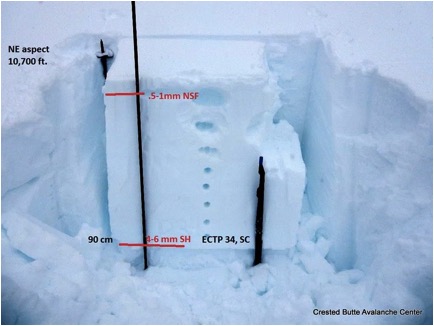
2/26/17 – Snow pit showing an example of the concerning crust facet sandwich in our snowpack.


2/23/17 – Small wind slab on a SE aspect NTL.

February 17th – 23rd: Unsettled Weather and Wind Slabs

CBAC2016 - 17 Weekly Snowpack Summaries, Weekly Snowpack Summaries

By Arden Feldman CBAC Intern

The week began clear and warm on February 17th but high clouds began to build on the 18th from a deep Pacific trough making landfall on the California coast. Moisture associated with the trough began streaming in from the southwest on the 18th but unfortunately the bulk of the energy and precipitation remained out near the west coast. Accumulations were only marginal with occasional light snow showers into the 19th. On the afternoon of the 19th a low pressure trough moved over Colorado, bringing with it a warm, moist air mass with southerly flow. This system brought snowfall through the night and resulted in 2 to 8 inches of snow across our area by the morning of the 20th, favoring the Kebler Pass and Paradise Divide zones. Strong westerly winds accompanied the new snow.

A temporary ridge built overhead on the 20th allowing for scattered skies and warm temperatures. Another Pacific trough began to move onshore on the 21st, quickly breaking down the ridge. Associated moist southwest flow stayed to our north and west in Wyoming and Utah. Being on the edge of this flow we saw increasing clouds and strong winds on the 21st and 22nd. The Elkton weather station recorded a 102 mph gust on the 21st. Finally on the morning of the 23rd a cold front drifted south over the Elk Mountains and brought steady snowfall with it. 8 to 10 inches of snow, driven by strong west to northwest winds, accumulated on the 23rd. The Schofield Pass Snotel Site recorded .5” of SWE and 10” of snow.

2/20/17 – Satellite image showing the break between storms on February 20th and the approaching system that would bring 100+ mph wind gusts and a quick blast of snow.


Persistent slabs on buried surface hoar 1 to 3 feet deep were the avalanche problem in the beginning of the week. The slabs were becoming increasingly unreactive but were still possible to trigger on near tree line northerly slopes. By the end of the week they had become unlikely to trigger. No new persistent slabs were observed this week and the last reported persistent slab occurred on February 14th in the Aspen Zone.

2/20/17 – Snow pit showing a 3 foot slab over propagating surface hoar on a NE aspect near tree line.


The new snow and strong westerly winds on the afternoon of the 19th built wind slabs on leeward aspects near and above tree line, and wind slabs were added to the problem list on the 20th. With continued strong winds and more snow on the 23rd, the wind slabs stuck around through the end of the week and kept the avalanche danger rating at moderate near and above tree line. They remained possible to trigger and small to large in size. During the second half of the week, several wind slabs were skier triggered and were responsible for a couple of close calls (Coon Basin, Purple Peak). ­­

2/20/17 – Remotely triggered wind slab that ran 1,500 feet.


2/21/17 – Crown of a large wind slab avalanche that caught, partially buried, and injured a skier.


2/20/17 – Skier triggered wind slab on an east aspect at Irwin.

Good Spring Conditions

CB Avalanche Center2016-17 Observations

Location: Kebler Pass Area
Date of Observation: 04/15/2017
Name: Evan Ross
Subject: Good Spring Conditions
Aspect: South
Elevation: 10,800-12,600

Avalanches: Some very small and slow running loose wet avalanches on slopes over 40 degrees in steepness.
Weather: Big and blue. Light westerly winds at ridgeline.
Snowpack: At 12,500ft the upper snowpack was made up of several crusts merged together to form last nights freeze down to 25cms. Percolation Columns extended below this depth into 4F- melt forms to an observed depth of 40cms.

Boot pen was about 10 to 15cms at 11am with some punching through the upper crust. Current high temperatures and solar gain plus light alpine winds didn’t allow snow surfaces to weaken beyond this at upper elevations. While lower elevations traveled, were much further along in the spring transition and stayed supportable through the end of our day at 2pm.

Mountain Weather 4/14/2017

CB Avalanche CenterWeather

Date: 04/14/2017

Clear sky Thursday night allowed for snow surfaces to freeze while valley temperatures dropped into the upper 20’s and 11,000ft temperatures to drop to right near freezing. High temperatures Friday should be should a couple degrees cooler then yesterday with another small decrees on Saturday. A low pressure trough will be moving by north of Colorado during this time period. This passing trough has brought increased gusty winds to the alpine for Friday morning into midday. By Sunday night into Monday, another passing trough looks to sag a little further south and at this point only looks to bring some increased clouds. There are a few chances for a change in weather looking out to next week, but currently nothing to promising. May be time to start shoveling your snowbanks into the melted out portions of your yard to start watering.

Mountain Weather 4/12/2017

CB Avalanche CenterWeather

Date: 04/12/2017

Its never a good sign for winter weather in the near future when weather discussions are talking about the fire conditions. Dry and warm as far as the eye can see could be the end of this weather discussion. Well, ok a few more points can be made. Cloud cover is decreasing this morning as we are back in warm and dry southwest flow. The pressure gradients will tighten tomorrow and we’ll see an uptick in gusty alpine winds with hight temperatures a couple degrees warmer then today. Winds looks to ease again by the weekend with high temperatures dropping a couple degrees. It all comes back to warm and dry weather into the extended forecast with a few blips of increased clouds maybe this weekend or next week.

Minimal Avalanche Issues

CB Avalanche Center2016-17 Observations

Location: Paradise Divide Area
Date of Observation: 04/11/2017
Name: Evan Ross
Subject: Minimal Avalanche Issues
Aspect: North East, East, South East
Elevation: 11,600-12,950

Avalanches: Plenty of old loose wet avalanches to be viewed. Mostly D1.5 or smaller in size at near and above treeline elevations on northeast to south to west aspects. All this activity looks to have happened previous to last weekend. Very little activity to be viewed below treeline.
Weather: Clear sky in the morning increased through the day becoming overcast by 2pm. Mostly calm to light winds at ridgeline.
Snowpack: Minimal avalanche issues observed. Didn’t encounter a loose wet concern. Isolated wind drifts up to 20cm’s deep were mostly unreactive.

Northeast: The northerly end of the aspect spectrum is staying dry, while the easterly end of the spectrum was warmed and produced some loose wet activity last Friday 4/7. These snow surfaces stayed dry today and sluffing was minimal. Last weekend storm snow was drifted to 20cm’s thick right near ridgeline with some stubborn cracking to 10ft, but no other results.

Southeast: Below 11,500ft the upper snowpack has made a nice transition to spring conditions and typical corn cycle setup. Above that elevation is still transitional. Boot pen is about 15cm-20cms deep breaking through the surface crust while frozen in the morning. Some portions of the slope are cross loaded to 20cms deep by last weekends storm with a ski supportable surface crust on top. While other portions of the slope are tinted brown, and blown down to the 4/7 interface. The 4/7 interface was also breakable to boots into colder snow below while supportable to skis. This surfaces warmed up in the afternoon with 5cm or so ski pen.

East 11,800-12,200: Hot, but not a mess. I don’t know if I like hot messes, but I know I don’t like just hot all-a-cart. Sweaty. Mostly traveled near ridgeline where last weekends new snow was baked in, and non problematic. Moist snow surfaces but no loose wet concerns.

Mountain Weather 4/10/2017

CB Avalanche CenterWeather

Date: 04/10/2017

Its going to be like Groundhog Day all week. Only each day your going to get hotter and more sweaty. The sun will come up each day, (feel like I will nail that part of the forecast), the temperatures will rise, westerly winds will be light to moderate, the sun will go down and boom! We’ll do it all over again the next day.

A blip in the westerly flow may bring some increased clouds late Tuesday into Wednesday. Then southwest flow will allow high temperatures to ramp up even more on Thursday and Friday. Settle in folks, its going to be a nice dry week ahead.

Mountain Weather 4/9/2017

CB Avalanche CenterWeather

Date: 04/09/2017

Well, at least last night’s storm brought the wind… and there’s cold air on the way.

A windy trough of low pressure is blowing across the western US this morning, with the substantial moisture tracking far away in the Northern Rockies. This morning as the trough axis passes overhead a cold front will drop temperatures several degrees and shift winds to the Northwest. For the last day of the ski area, expect a cool breezy day, with clouds decreasing as the day goes on. The winds look to calm down as the lifts stop spinning.

For those partaking in the traditional closing day rituals, you might consider bringing a wind-proof sock.