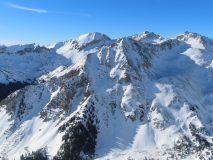

West Elk Wilderness obs

CB Avalanche Center2020-21 Observations

Date of Observation: 01/18/2021
Name: Ben Pritchett

Zone: Northwest Mountains
Location: West Elk Wilderness
Aspect: East, South East, South
Elevation: 9,300-11,600′

Weather: Ridgeline Wind Speed: 10-20 mph
Ridgeline Wind Direction: NW
Wind Loading: Light
Temperature: 17 F
Sky Cover: Broken
Depth of New Snow: 1 cm
Depth of Total Snow: 70 cm
Weather Description: Overcast at sunrise turning to partly cloudy by late morning. Brisk winds at ridgetop did not have much snow to move.

Snowpack: On east to southeasterly-facing terrain below and near treeline we found a generally faceted snowpack with an exceptionally weak snow surface. We moved through and over lots of avalanche terrain with no collapsing or shooting cracks. We skirted around the margin of one recently wind-loaded slope just below the ridge crest. In a lower angled part of this slope we found an ECTX 17 (slab fracture), that popped cleanly in a compression test on the Dec 11 interface (top of the large-grained depth hoar below an old melt-freeze crust). This structure would probably not propagate across a slope given the weakening slab, but with additional loading I would anticipate the old Persistent Slab problems will come back to life. Even now, if there was a portion of this slope with a stiffer mid-pack slab I would expect to get different (propagating) results. With a bit of uncertainty, we opted out of center punching the steepest parts of slope. While the chance to trigger might be lower, any avalanche would probably gouge to the ground and grow large South-facing slopes had a well developed sun-crust capping a layer of very weak facets. Not good news once slabs develop on top.

A bit of soft snow, mostly wind hammered surfaces and a triggered avalanche

CB Avalanche Center2020-21 Observations

Date of Observation: 01/18/2021
Name: Zach Kinler
Zone: Northwest Mountains
Location: Anthracite Mesa
Aspect: East, South West, West, North West
Elevation: 9,400′-11,000

Avalanches: Observed the previously reported skier-triggered slide in the Purple Palace exit. HS-ASu-R1-D1.5-I

Weather: Lovely in sheltered terrain below treeline with temps around freezing, calm to light breezes. Light to moderate NW wind still pumping in open areas and closer to ridge line.

Snowpack: Mainly looking for soft snow in sheltered west-facing terrain on a quick rec tour. Previous travel in this area revealed HS in the 80-90 cm range before the recent wind event. Today HS was more like 60-70 cm with open areas being mostly scoured revealing past skin/ski tracks. Suttle terrain changes on these cross-loaded aspects created thin, small and very stiff(Pencil hardness) slabs. Avoided steep slopes involving terrain traps where these isolated slabs were found.

Visited the skier-triggered avalanche on the exit from Purple Palace on the way out. This terrain was a steep, East facing open slope where recent winds created a drifted pocket at the top the run. Once triggered, this small slide quickly accelerated downslope entraining mainly surface snow before stacking up deeply at the creek bottom below. Perfect example of how a small and isolated problem becomes magnified by the terrain.


Unintentional skier triggered slide

CB Avalanche Center2020-21 Observations

Date of Observation: 01/18/2021
Name: Mark Robbins

Zone: Northwest Mountains
Location: Purple palace exit
Aspect: East
Elevation: 9,750-10,000

Avalanches: Unintentionally triggered a small wind slab at the entrance to the exit slope of purple palace which propagated and entrained most of the season’s snowpack, running with energy through small trees about 300 vertical feet to the creek. Didn’t get an exact read on the depth of the debris pile but may be close to 6 feet. I believe I caught the bottom edge of the slab, the crown is maybe 15 feet above my entrance track. I saw the slab breaking around me and immediately skied traversing to the right to exit the slide.
Extreme moment of complacency not identifying the obviously windloaded pocket and high consequence of the relatively small avalanche problem due to the terrain trap. Low danger rating, minimal feedback earlier in the tour, and being so close to the end of the tour, added to the recipe for complacency. In retrospect the entrance was obviously windloaded and should have been quickly identified as a hazard.

Photos:

No Signs To Instability, Still Some Nice Snow In Protected Areas

CB Avalanche Center2020-21 Observations

Date of Observation: 01/17/2021
Name: Evan Ross

Zone: Northwest Mountains
Aspect: West, North West
Elevation: 10,500-11,200

Snowpack: Traveled through westerly facing terrain features at both BTL and NTL elevations. I’ve been through that area 2 other times in the last couple of weeks. Each time now on a slightly different route. Basically, on 1/6 traveling through that area produced some alarming and far running shooting cracks. On 1/12 there were still some concerning shooting cracks and uninspiring red flags, but a little quieter than back on 1/6. Now today, there was still some nice soft snow in protected areas, but no avalanche concerns due to a heavily faceted snowpack. While the hard slabs we traveled on at both BTL and NTL elevations also didn’t show any signs of instability. Today was the first time I wasn’t concerned about triggering an avalanche in that terrain. Spent a bit of time traveling other aspects, N,E,S… also with no signs to instability.

Sugar Shack

CBAC2020-21 Observations

Date of Observation: 01/17/2021
Name: Zach Guy

Zone: Northwest Mountains
Location: East Beckwith
Aspect: East
Elevation: 10,000 – 11,600′

Avalanches: None
Weather: Light northwest winds. Partly to mostly cloudy.
Snowpack: We traveled on several steep east facing slopes near and above treeline without signs of instability. A lot of ski pole probing easily going to the ground indicated the persistent slab structure was mostly faceted away. We dug a test pit in a concave part of the bowl holding a deeper, denser snowpack. Despite an unnerving looking structure (see photo), tests produced non-propagating results. We chose to avoid this part of the bowl, regardless.
Last week’s winds did little to damage the weak snow surface here, apart from forming a thin windcrust above the facets at higher elevations. All elevations that we traveled on have a persistent weak layer continuous across the terrain (1-1.5mm, Fist hard). Meltfreeze crusts are on anything with a hint of south and grow thicker with southerly tilt. See photos and captions for details.


Photos:

Snoddy Toddy

CB Avalanche Center2020-21 Observations

Date of Observation: 01/16/2021
Name: Chris Martin


Zone: Southeast Mountains
Location: Snodgrass/Gothic Road
Aspect: North, North East, East
Elevation: 9600-10000

Avalanches: D1 Avalanche on East Facing aspect, Hard slab, looks to be 30cm thick, Naturally triggered. Not sure if it released today or prior to today.
Weather: Partly cloudy AM into a blue bay day
Snowpack: Hunting for wind load, found on Easterly slopes BTL in isolated pockets. They began as thin crusts and with some hunting we found 6-12″ hard slabs, Pencil hard. Cracking beneath feet to about 6′ around some of us and one that shot our fairly far, see photos.

No propagating test results, only dug in areas where there was no wind affect and deteriorating slabs existed, did not dig in wind slab.

Depth Hoar at base of pack is growing in size (NOV 6th Layer 3-4mm FC/DH). The Dec 10th FC layer down 45cm is also exhibiting signs of facet growth. Slab above Dec 10th layer F-4F and continuing to deteriorate.


Photos:

wind slab hunters

CBAC2020-21 Observations

Date of Observation: 01/16/2021
Name: Zach Guy

Zone: Southeast Mountains
Location: Various valley locations near Crested Butte
Aspect: North East
Elevation: 8900-9200′

Avalanches: None
Snowpack: We targeted a handful of obvious windloaded features from strong valley winds near town. Wind drifted slabs were 2″ to 5″ thick, pencil hard. Some would crack after undercutting and stomping on the slope, others would crack as we crossed the slope, with shooting cracks up to 10′.  Slabs were all small and localized to easily identified features such as rollovers or in gullies.
The rest of the terrain that we traveled on was all bottomless facets with some wind texture on the surface.


Photos:

BTL snowpack is like a box of chocolates

CB Avalanche Center2020-21 Observations

Date of Observation: 01/16/2021
Name: Andrew Breibart

Zone: Southeast Mountains
Location: Walrod
Elevation: BTL

Avalanches: NA
Weather: calm winds at the surface and near/above freezing temperatures early AM. Mostly cloudy transitioning to partly cloudy skies.
north winds ATL and above appeared to be moderate by movement of winds but no wind transport observed on ridges.
Snowpack: Trace of graupel (1mm) in size.
Strong winds Wednesday and Thursday created a mosaic of stiff and soft wind slabs on all aspects in openings. Poking around in other areas resulted in unsupportive snow up to 12 inches. The snowpack here is shallow or devoid on southerly aspects with high incoming UVA radiation.

Snowpack is best summed up Forrest Gump: https://www.youtube.com/watch?v=cgZXC1OGhR8


Toto, we’re not in Kansas anymore

CBAC2020-21 Observations

Date of Observation: 01/15/2021
Name: Zach Guy, Zach Kinler, Jared Berman


Zone: Southeast Mountains
Location: West Brush Creek towards Coffee Pot Pass
Aspect: East, South, West
Elevation: 9,000 to 12,800′


Avalanches: We intentionally triggered a hard slab avalanche on a small, heavily windloaded terrain feature on an east aspect below treeline. The slab was about a foot thick and about 300 feet wide, D1.5 in size. It was made up of windrifted snow failing on weak facets.
Weather: Clear skies, mild temps, periods of moderate to strong gusts drifting faceted snow.
Snowpack: We traveled mostly on low angle terrain below treeline and some steeper slopes on westerly aspects near and above treeline. Below treeline, we triggered about a dozen collapses and shooting cracks on the 12/10 interface which is about 15″ down, 4-5mm depth hoar. Collapses were mostly in concave or leeward terrain features that had collected additional windloading from last night’s winds. Wind drifts were pencil hard, 2″ to 8″ thick on average, and localized to mostly just drainage bottom. The drifts themselves also cracked easily under our weight where they formed on near surface facets. As we gained elevation, it appeared that winds mostly just scoured snow away on all aspects. The few drifts that we found were thin and unreactive. On steeper westerly aspects, we didn’t observe any signs of instability; the snowpack is generally thin and all weak facets, apart from a wild mess of firm wind crusts and sastrugi on the surface.
We targeted a test pit just above the crown of a large avalanche that ran naturally in late December on an east aspect above treeline. The slab was 60 cm thick, and is faceting throughout, but still has about 10 cm of 1F- in the midpack. The failure layer was 2-3 mm facets either above or below a soft (4F) decaying meltfreeze crust. Stability tests on the structure today produced hard, non propagating results in an extended column test (ECTN28 x 2), and propagating results in a propagation saw test (PST40/100 END x 2 on 20201210) just above the crust.


Photos: