
January 1st – 6th: Major Storm Impacts the Area

CBAC2016 - 17 Weekly Snowpack Summaries, Weekly Snowpack Summaries

By Arden Feldman            CBAC Intern

The New Year began with two low-pressure systems, one in the northwest, and another off the California/Baja coast creating a stream of moisture from the Pacific into Colorado. This produced 12-18” of low density snow across the area. CBMR reported 14” of snow and .3” SWE over the two days. Winds out of the southwest averaged 10-25 mph above tree line with gusts in the 50’s.

1/1/17 – Satellite image from the National Weather Service showing the two low-pressure systems, one in the northwest and another off the California/Baja coast. Clouds can also be seen beginning to form over Colorado.


The storm picked up in intensity from the night of January 3rd through the 5th. The jet stream lined up overhead producing a west-southwest flow and providing abundant moisture from the Pacific. By the morning of January 5th, Schofield had received 3.7” of SWE and 30” of snow since January 1st. On the 5th, a powerful cold front slowly sagged south over Colorado and the Crested Butte area got pummeled with snow falling at 2-3” per hour rates throughout the day. After the cold front passed, measured storm totals since New Year’s Day were 5.56” of SWE and 57” of snow at Irwin, 5” of SWE and 41” of settled snow at Schofield, and 47” of snow at CBMR. Behind the front, colder, drier air moved in, leaving clearing skies and frigid temperatures in its wake for January 6th.

1/4/17 – Satellite image from the National Weather Service showing the abundant moisture flowing into Colorado from the Pacific.


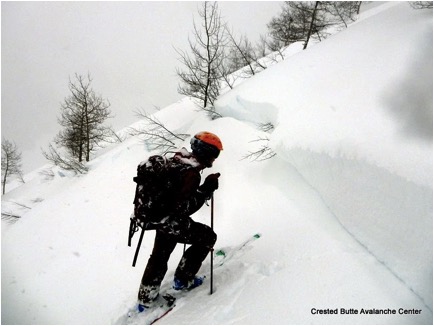
There were a number of problematic surfaces at the storm interface that had formed over the previous dry week, including near surface facets, surface hoar, melt-freeze crusts, and slick wind crusts. The storm created a sizeable slab that was sitting on those interfaces and persistent weak layers. The observed human triggered and natural avalanches grew larger in size as the storm progressed. Initially, there were touchy, relatively shallow storm slab instabilities, even with surprisingly low density and incohesive slabs. By the later parts of the storm, larger avalanches were failing naturally on these interfaces. The avalanche danger was rated as HIGH on both January 4th and 5th and a major natural avalanche cycle occurred with reports of many D2 to D3 avalanches around the zone. There was even some avalanche activity that 45-year locals had rarely seen.

1/3/17 – Skier triggered D2 storm slab on Schuylkill Ridge that failed on a surface hoar layer buried at the beginning of the storm.


1/6/17 – Natural D2.5 Persistent Slab avalanche on a southeast aspect of Purple Peak.


1/6/17 – Natural D2.5 persistent slab avalanche on an east aspect of Mt. Owen.


1/6/17 – CBAC Snodgrass Snow Study Plot profile showing the snowpack after this week’s major storm.

December 20th – 31st: Small Storms with Strong Winds lead into a Brief Dry Spell

CBAC2016 - 17 Weekly Snowpack Summaries, Weekly Snowpack Summaries

By Arden Feldman            CBAC Intern

From December 20th to 22nd, the snowpack continued to stabilize after the major December 16/17th storm. Valley inversions dipped to -15 in town.

12/22/16 – CBAC Snodgrass Snow Study Plot profile showing the stabilizing snowpack after the December 16/17th storm. 


A warm southwestern system impacted the Elks on 22nd. The storm brought with it snowfall rates up to 2” per hour and 20-30 mph west winds above tree line. Schofield received 14” of snow and 1.3” of SWE and CBMR received 8” of snow and .8” of SWE. The avalanche danger rose to considerable at all elevations on the 23rd and observers reported natural and skier triggered storm slabs.

On the 23rd and 24th, winds out of the south averaged 15 mph with gusts up to 64 mph at the Elkton weather station. These strong southerly winds created unusual loading patterns on north faces. For example, the north face of Ruby Peak had been wind scoured near to the ground during the 12/16 storm, but was reloaded by southerly winds, and produced two natural slabs, breaking 2-3 feet deep. A large slide also ran to the valley floor off of Gothic.

12/24/16 – Pair of 2-3 foot soft slabs that ran naturally on the north face of Ruby Peak, failing on old snow at the ground.


12/24/16 – Natural avalanche on northeastern aspect of Gothic Mountain.


A cold front brought snow and strong winds from the west on the 25th. 7-14” of snow fell across the zone with Schofield picking up 8” and .8” of SWE. The strong winds formed sensitive wind slabs on leeward slopes.

12/24/16 – Satellite image from the National Weather Service showing the Christmas storm on its way to Colorado.


12/25/16 – Small skier triggered wind slab near tree line on an easterly aspect.


The 26th of December through the end of the year was characterized by dry conditions, with powerful southwesterly winds, cold temperatures, and strong solar radiation. Over this time period, the avalanche danger slowly fell. Wind slabs were a significant issue during the first part of this timeframe due to the strong winds and ample snow available for transport. The wind slabs did eventually heal and persistent slabs became the main avalanche concern. Although slowly healing there were still instabilities in the middle of the snowpack in the form of near surface facets and surface hoar buried during the Christmas storm. And of course the snowpack’s basal weak layers still provided cause for concern of deeper instabilities especially near and above tree line on steep, rocky faces and bowls. Several large avalanches ran naturally on basal weak layers over this time.

12/27/16 – Slab avalanche on Schuylkill Ridge that failed on a mid pack instability.


12/26/16 – Natural, 3-5 foot deep, D2.5 persistent slab avalanche in the Anthracites that ran on or near the ground.


With clear skies, cold temperatures and strong solar radiation, future persistent weak layers formed at the snow surface during the dry spell at the end of the year. On southerly aspects, stout melt freeze crusts formed, while northerly aspects experienced near surface faceting.

Executive Director/ Lead Forecaster Job Announcement

CBACAnnouncements, News

The Crested Butte Avalanche Center (CBAC) is seeking to fill the positions of Executive Director and Lead Avalanche Forecaster to begin in the spring or fall of 2017.   The ideal candidate will fill both roles, but we encourage those interested in only one of the roles to apply. The Director/Lead Forecaster of the CBAC is a full-time, seasonal position. The incumbent will oversee all operations of the CBAC including the creation of avalanche advisories, avalanche education and outreach, fundraising, and collaborative efforts, while supervising employees, including other avalanche specialists.

The position is salaried for a 6 month season (October 15 through April 15), with some part-time work commitments required during the off-season.  Starting salary will range from $18,000 to $25,000, depending on qualifications and experience.  See below for job description and desired qualifications. For questions about the position or job qualifications, contact Zach Guy (zach.guy@gmail.com).  To submit an application, please send a complete resume, cover letter, and at least three references to cbavalanche@gmail.com.  Applications are due by February 3rd, 2017. Depending on availability of applicants, the position will begin in March of 2017 or October of 2017.

The Crested Butte Avalanche Center’s (CBAC) sole purpose is to prevent the loss of life, limb, and property to natural and triggered occurrence of avalanches in the backcountry surrounding Crested Butte. CBAC is a 501 (c) 3 non profit organization. The Crested Butte Avalanche Center is an Equal Opportunity/Affirmative Action Employer.


EXECUTIVE DIRECTOR  job description

  • Working with the Board of Directors, oversee, plan, and manage an operational budget.
  • Supervise and manage all staff (including forecasters and development director), recruit and hire staff, assign/schedule work, communicate performance expectations and evaluate performance to staff, develop performance improvement plans, resolve informal complaints, and ensure that subordinate staff are trained and coached to assigned work in accordance with job descriptions and expectations.
  • Plan and budget professional education and training opportunities for staff, including ISSW, CSAW, and other courses.
  • Write, acquire, and manage grants to fund projects and program work
  • Design sponsorship packages and requests and seek sponsorship opportunities by fostering relationships with local, regional, and national businesses and partners.
  • Lead in the organization, promotion, coordination, and execution of fundraising, outreach, and educational events.  Coordinate and meet with CBAC board of directors to plan, organize, or review events and fundraising.
  • Attend, present at, or set up booths at various events to enhance outreach, such as the outdoor industry films, info fairs, Avalanche Awareness Nights, and other public or non-profit events.
  • Establish and promote private donation opportunities through membership drives, meetings, events, website, and personal communication.  Seek to design or conduct new or alternative fundraising opportunities through events, grants, sponsorships, and donors.
  • Seek and produce new or progressive education or outreach opportunities or events for the public
  • Oversee and carry out office space rental and setup, and computer and internet support.
  • Oversee licenses, insurance, workman’s compensation, and other operational logistics.
  • Provide ongoing guidance, coordination, and training to staff and volunteers.
  • Oversee the purchase, licensing, insurance, maintenance, storage, and management of CBAC equipment, including snowmobiles, snow safety, and field equipment.

LEAD AVALANCHE FORECASTER job description

Minimum Qualifications:

  1. Bachelor’s or higher degree in a science related field.
  2. AIARE Level 3 certification, AAA AVPRO, CAA Level 2, or equivalent experience/certification.
  3. Three years of professional snowpack evaluation experience.
  4. Proven proficiency in weather forecasting, field observations, public communication, and computer skills.

Job Description:

  • Create and oversee the production of daily mountain weather and avalanche advisories/warnings for a large geographic area surrounding Crested Butte, CO.
  • Provide expert leadership and guidance in regards to analyzing the snowpack to direct and conduct field work and to oversee the development of avalanche advisories and avalanche warnings.
  • Design, prepare, and conduct training exercises for staff, including safety protocols, field work standards, and workshops in writing, weather forecasting, avalanche danger and problems, video production and editing, website design, and more.
  • Oversee and supervise the safety and quality of forecaster fieldwork by establishing safety and communication protocols for fieldwork.
  • Manage the “Pro Observers Program” and internship program.
  • Manage, analyze, and oversee the recording and maintenance of weather, snowpack, and avalanche data for producing and assessing the quality of forecasts, pattern identification, and scientific studies.
  • Manage and maintain CBAC’s website (www.cbavalanchecenter.org) and implement website improvements using a working knowledge of safety messaging and design, computers, internet applications, word processing, and spreadsheets
  • Create, edit, and manage messaging to the public through multiple media platforms including website, email, social media platforms, radio and phone recordings, and print.
  • Present at or lead in CBAC educational/ awareness classes or events to the general public using power points, videos, in-field demonstrations, and public speaking.
  • Facilitate and maintain CBAC’s collaboration and partnership with the Colorado Avalanche Information Center (CAIC) and the National Avalanche Center (NAC) through regular communication, data and information sharing, and more.
  • Manage informal collaborations and mutually benefiting partnerships between local ski resort and guiding operations.
  • Oversee the maintenance and operation of CBAC weather stations within the forecast area.
  • Write or contribute content to avalanche related articles in local, regional, and national newspapers, magazines, journals, and blogs.
  • Design and conduct research to improve forecast quality or promote the advancement of scientific understanding of snow and avalanches.  Seek to improve or integrate forecasts and safety messaging to the community via alternative or new methods.
  • Maintain and dispense to forecast staff a professional knowledge of snow physics including snow metamorphism, the distribution patterns of common weak layers, the mechanics of slab failure and classification of snow crystals by attending conferences, workshops, and reviewing literature, journal articles, conference proceedings, and other media.
  • Attend and/or review minutes and proceedings from industry related meetings, such as ISSW, National Avalanche Center, National Oceanic and Atmospheric Administration, and more to stay current with industry policies, standards, and updates.
  • Provide daily feedback on the accuracy and quality of staff-produced avalanche forecasts. Lead forecaster meetings and discussions between staff pertaining to avalanche concerns and forecasts.
  • Establish, maintain, and manage a study plot to aid in snowpack analysis and studies for solving avalanche problems.
  • Respond to avalanche incidents, conduct accident site investigations and interviews, and produce reports of avalanche accidents to industry standards.
  • Produce season-end summaries and reports including season snowpack and avalanche summaries and user statistics and reports.
  • Respond to media inquiries about avalanche conditions or accidents. Respond to avalanche related requests and inquiries, such as requests for recreational or professional training, educational presentations, feedback on publications, and more.
  • Coordinate the relationship with and production of newspaper, radio, and television broadcasts and public service announcements for avalanche information and warnings.
  • Oversees and review daily Skype meetings between CBAC and CAIC staff to ensure compliance, quality, and comprehension of forecast problems
  • During periods of dangerous avalanche conditions, monitor conditions throughout the day and communicate with CAIC to issue watches and warnings.  Relay avalanche watches and warnings through all media and public messaging outlets.
  • Analyze, evaluate, and verify raw meteorological, snowpack, and avalanche data from instruments and observations to write and issue daily public weather and avalanche advisories for regional snow stability and avalanche hazards.  Avalanche advisories include avalanche danger ratings for three elevation bands, avalanche problems (size, distribution, and likelihood), travel advice, and a detailed discussion.
  • Evaluate weather maps and models, weather forecast products, and data for producing daily mountain weather forecasts to be used in conjunction with avalanche advisories.
  • While working in harsh winter environments, use expert skills in snowmobile and alpine ski touring to travel through steep, avalanche terrain in order to conduct fieldwork and avalanche condition assessments.  Regularly operate snowmobiles and skis in deep powder, icy conditions, and difficult terrain, including but not limited to steep slopes, rough terrain, poor visibility, and areas with high avalanche danger.  
  • Perform basic repairs on snowmobiles. 
  • Observe, collect, and measure meteorological, snow, and avalanche phenomena with scientific equipment and instrumentation while traveling through backcountry terrain.  Conduct snow stability tests and record snowpack observations in the field to industry standards.
  • Publish snowpack, weather, and avalanche observations on CBAC and CAIC’s data platforms, including media, snow profiles, and video content for improved comprehension by the public. Film, edit, and publish videos pertaining to avalanche conditions.  
  • Analyze and review data to confirm and improve the accuracy and efficacy of daily forecasts and products.
  • Disseminate daily avalanche advisories through website, email, social media platforms, telephone, public radio, and other outlets.