



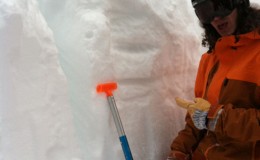
CBAC forecasters Zach Guy and Evan Ross investigate the crown of a slab avalanche that occurred around 12/22/14, and demonstrate the current persistent slab problem.
Crested Butte Zone
Name: Donny, Will
Date: 2014-12-28
Activity: Level One Avy Course, Tour Day
Location: Red Coon Glades
Elevation: 9200′ – 11,600′
Aspect: S – SE
Weather: Overcast to obscured skies, snowfall throughout day, periods of S2, but less than 5cm accumulation throughout day. Snow was mostly DFs with a short period of graupel. Light wind most of the day, with moderate W/SW winds above 11,000′. -13ºC at 9200′ @ 10:30; -18ºC at 11,600′ @ 13:00
Snowpack & Avalanche Obs: Not much new to report. Dec. 13th interface still present above 10,000′. More solar aspects present a harder crust, shaded aspects are more faceted. Nothing new here. Top 3cm of new snow was denser than bottom 2-3 cm due to increased winds. No signs of avalanches or instabilities.
Crested Butte Area
Name: Will Dujardin
Location: Snodgrass Weather Station Pits 12-28-14
Date of Observation: 12/28/2014
Aspect: North East
Elevation: 11120
Weather: Light snow and low clouds, very light wind.
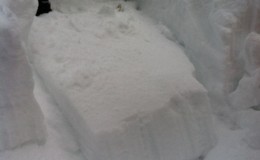
Snowpack: We dug two pits just approx. 3.5 feet deep to the ground right next to each other on slightly different slopes (30 degrees and 37 degrees) on the NE aspect just below the weather station. We isolated two blocks to test the storm snow and the persistent slab in both pits. The 18~” of storm snow sluffed away in both pits to shovel taps. The 30 degree pit we were able to get the isolated persistent slab to go with applied boot pressure, in the 37 degree pit we had the storm slab (just above the top of the shovel in photo 1) go with a single skicut to the back, like a Rutschblock test of sorts, and the persistent slab to go with a boot kick in the same spot. See attached photos to see what the ski cut did in the 37 degree pit. It seems like it’s definitely harder, but not that hard, to trigger that persistent slab, and the slab formed from the recent storms is very touchy, it could definitely knock you down or bury you in a terrain trap, and if it stepped down to the persistent slab it would result in a massive avalanche . We skied back the low angle E-SE aspects to avoid the NE avalanche problem. Sorry for the lack of technical terminology!
Uploads:
Mountain Weather December 29, 2014
Date: 12/29/2014
A winter weather advisory was issued for our area. Last night we received light snowfall and are anticipating the snowfall to increase today. Northwest and southwest winds are converging along with a cold front and creating a band heavier snowfall in northern Colorado. This band will continue moving south today but the big question is weather all these things line up over the Elk Mountains as this system move south. If so, we’ll see the higher end of snow forecast numbers and if not, we’ll see continued light snowfall. The western portion of our zone should do ok either way with favorable orographics. We’ll see lingering snowfall on Tuesday as this weather system splits off to the south and shows some love for the San Juan Mountains. Wednesday will be drier with more weather anticipated on Thursday.
Today
High Temperature: 10
Wind Speed: 5-15 G20
Wind Direction: SW, W
Sky Cover: Overcast
Snow: 4-8
Tonight
Low Temperature: -5
Wind Speed: 5-15
Wind Direction: SW, W
Sky Cover: Overcast
Snow: 2-4
Tomorrow
High Temperature: 10
Wind Speed: 5-15 G20
Wind Direction: S
Sky Cover: Overcast
Snow: 0-2

What are facets?
By Zach Guy
CBAC Forecaster
If you’ve been reading our avalanche advisories lately, you’ve probably noticed we’ve been talking a lot about facets. Last weekend, major winter storm slammed into our mountains, and we saw widespread avalanche activity, with facets being one of the major culprits. So what is the deal with this snow grain type, how does it form, and why is it so problematic?
Facets are a sugary-like snow grain. They glisten in the sun, bounce in your glove, and commonly make a noticeably soft or hollow layer in the snowpack. If you look at them under a magnifying glass, they have many flat edges, hence the name facets.
|
| Courtesy Photo |
There are several different ways that can cause snow grains to facet, but they all share the same underlying physical process. Facetsform when water vapor moves quickly through the snowpack. Each particle gets handed off between grains, via sublimation and deposition, causing the grains to reconfigure into a more angular form. Strong temperature differences within the snowpack cause this water vapor relay. We can see facets form early season when the ground is quite warm, there is a shallow snowpack, and the air gets cold, especially at night. This drives the water vapor upward through the snowpack causing it to facet, or rot out. We also see a similar process occurring on top of the snowpack, called “near surface faceting.” When we get warm days and cold, clear nights, the snow surface undergoes wild temperature swings, causing the same rapid water vapor movement. This process is expedited if the surface is composed of soft, low density snow, rather than stiff, hard, compacted snow. All of these ingredients have come together this winter. We have seen basal facets form during the early season when our snowpack was shallow. Then, on December 1st, we got about 4″ of new, low density snow, which was followed by two weeks of warm days and cold, clear nights. That surface snow metamorphosed into fragile, sugary grains, and we didn’t get strong winds that can sometimes destroy that layer as it is forming. On December 13th, that near surface facet layer was buried, and it is now under the weight of all the new snow that has fallen in the past 2 weeks.
Facets form a type of layer in the snow coined as a “persistent weak layer.” So once a layer of facets gets buried by a slab of new or windblown snow, it makes for a weakness in the snowpack on which avalanches can fail. Worst of all, the weakness is long-lasting, so we can see avalanches fail on facet layers weeks or months after they are buried. This means that we can see very large slabs of snow develop over the course of the winter before a facet layer might finally give out, causing a huge avalanche. Facets have a few other nasty tricks up their sleeves. If the layer is fairly continuous, it is so fragile that it can drive a failure very long distances across avalanche terrain. I’ve seen avalanches fail almost a mile wide on facet layers!! If you can get the layer to collapse on flat terrain, it can propagate up a slope and cause an avalanche to release above you. So not only do these layers plague us for long periods of time, but they also behave in an unusual manner. Keep this in mind in upcoming weeks and months, now that we have several facet layers buried in our snowpack. For more information or to get daily avalanche advisories, visit www.cbavalanchecenter.org.
 |
| This is a photo of a shallow slab that propagated impressive distances on the December 13th facet layer, near Purple Palace. Photo credit: Aaron Huckstep |
Ian’s Weather Resources
Current Data
Surface:
http://weather.rap.ucar.edu/surface/
https://avalanche.state.co.us/obs_stns/stns.php
http://mesowest.utah.edu/cgi-bin/droman/mesomap.cgi?state=CO&rawsflag=3
Schofield SNOTEL: http://www.wcc.nrcs.usda.gov/nwcc/site?sitenum=737
Upper-air soundings:
http://weather.rap.ucar.edu/upper/
Radar & Satellite:
http://www.weathertap.com ($84/yr, great mobile website as well)
Discussions
NWS: http://www.nws.noaa.gov/view/prodsByState.php?state=CO&prodtype=discussion
OpenSnow: http://opensnow.com/dailysnow/colorado
CAIC: http://avalanche.state.co.us/forecasts/weather/zone-forecast/
http://wasatchweatherweenies.blogspot.com
Forecast Models: Twisterdata.com
Top Center
NAM = 84hr 12km resolution
GFS = 384hr 27km resolution
RAP = 18hr 13km resolution
Left Side
700mb = orographic wind direction
500mb = vorticity
300mb = jet stream
Upper Right
Clickable map = one forecast image
Animated loop = all forecast images
Compare models = toggle between each model
dProg/dt = see the trend in the forecasts
Forecast Models: CAIC
High-resolution version of the NAM model
Graphics: http://avalanche.state.co.us/forecasts/weather/model-forecasts/
Points: http://avalanche.state.co.us/forecasts/weather/point-forecasts/
Forecast Models: Weatherbell.com
Access to European model graphics and many other models. Fantastic data. $185/year
Kebler Pass Area
I groom for the snowmobile club. I was coming down the east side of Spain’s today, heading north. There was a sizable slide across the trail. It’s been somewhat covered by fresh so I guess it’s a few days olds but it was a good 150′ wide and looks as if it slid form 200′ no idea how deep it was. It took a few 10″ trees with it.
Crested Butte Area
Name: Donny Roth
Location: Snodgrass
Date of Observation: 12/27/2014
Aspect: East, South East
Elevation: 9500-10500
Weather: Few Clouds (mostly convective near high peaks), Calm winds, 4ºF @ 1200 & 10ºF @ 1500
Snowpack: Snow surface DFs going to facets, Ski Pen 10cm, Boot Pen 60cm; HS 70 to 100cm. Widespread, faint whumpfing on flats, no cracking, some noticeable collapsing. Snow cat triggered avalanche on road cut (D1) on 37º degree SE aspect. CTs and RBs produced clean, clear results (mostly CTMs and an RB3 and RB4 – this was a Level I avy course) on “Dec. 13th” interface, now about 50cm down from surface.
Avalanches: Let’s stay heads up. RLB got shredded and the ski quality is excellent right now. The new snow since Dec. 13 is pretty “right side up,” offering solid support while skiing. But that interface is shit. I think confidence levels will go up faster than the problem goes away. In my opinion, all north aspects and any slope with bigger consequences should be approached cautiously and conservatively.
Mountain Weather December 28, 2014
Date: 12/28/2014
The next storm to affect our area is moving in from the northwest today. This shortwave trough will bring snow and more cold artic air to northern Colorado this morning, before moving into our area and central Colorado this evening. Snowfall associated with this storm will be best tonight and Monday as additional shortwave energy continues to carve out a large trough over the Northern Rockies. Also, orographics will likely play a roll in the western portion of the Elk Mountains where we’ll see the highest snowfall amounts. Weather forecasters and us avalanche geeks are getting exited about this artic air and the potential for some vary low density powder.
Today
High Temperature: 14
Wind Speed: 10-20 G35
Wind Direction: W
Sky Cover: Mostly Cloudy
Snow: 0-2″
Tonight
Low Temperature: -3
Wind Speed: 10-20 G35
Wind Direction: W
Sky Cover: Overcast
Snow: 2-5
Tomorrow
High Temperature: 10
Wind Speed: 5-15
Wind Direction: SW, W
Sky Cover: Overcast
Snow: 2-5
Ohio Pass
-

- Widely propagating persistent slab on Ohio Pass from 12/22
-

- Widely propagating persistent slab on Ohio Pass from 12/22