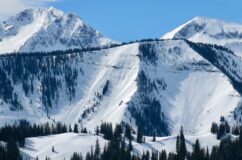
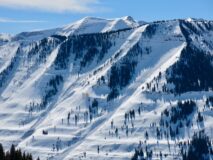
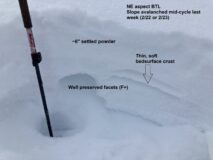
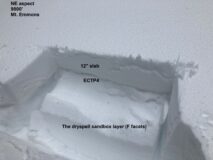
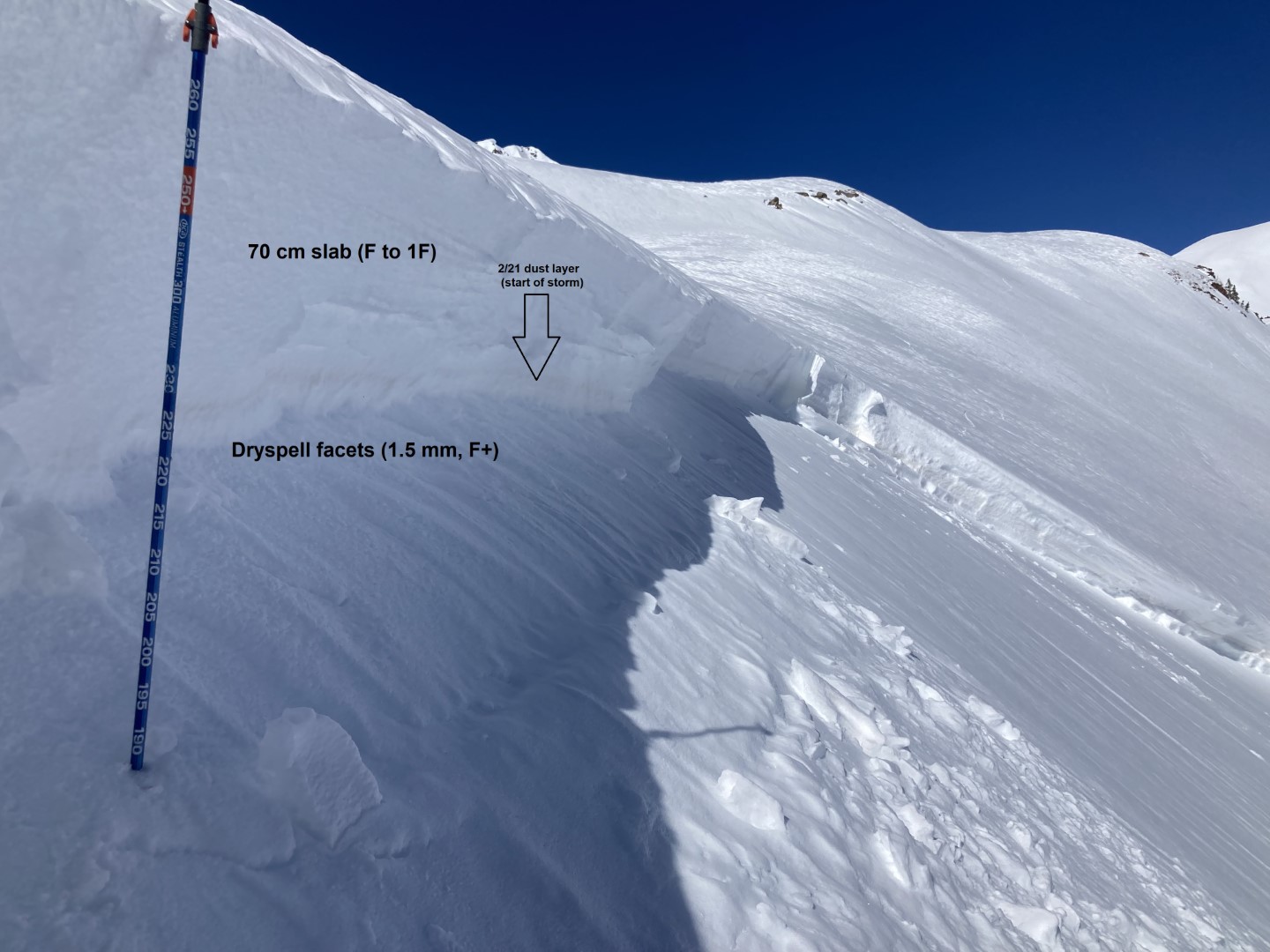
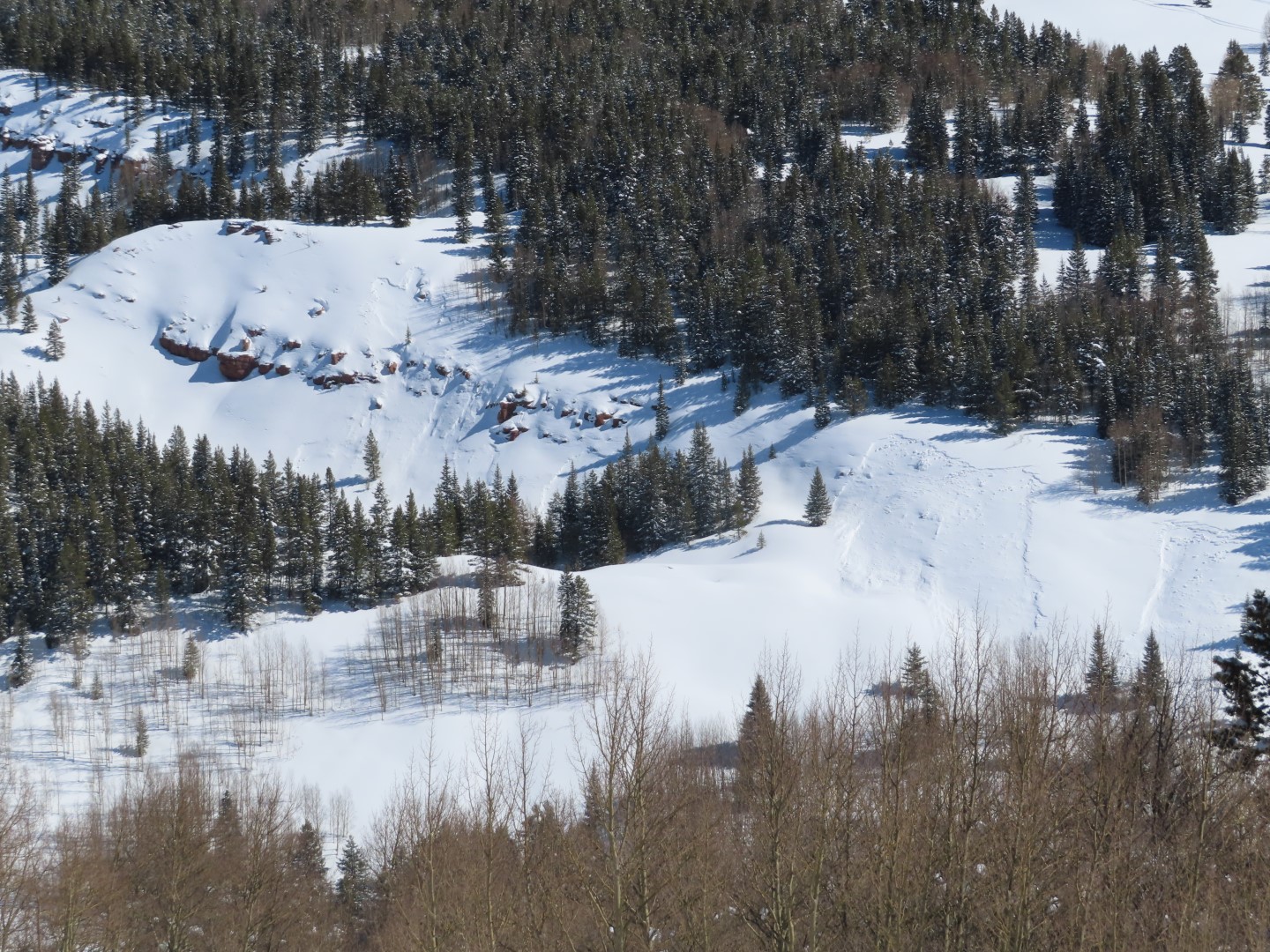
The sandbox is alive and well on bedsurfaces from last week’s cycle.

CBACCBAC Observations

Date of Observation: 03/04/2022
Name: Zach Guy and Jack Caprio

Zone: Southeast Mountains
Route Description: Mount Emmons Happy Chutes area. Traveled on E and NE aspects to 10,000 ft.

Observed avalanche activity: Yes
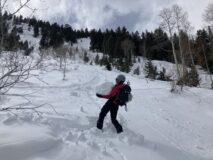
Avalanches: Skier triggered a handful of moist loose avalanches on NE aspects below treeline, D1 to 1.5 in size. They entrained more snow than you might expect because the moist surface snow plowed through the sandbox of dry facets below once sluffs started gaining momentum.
Weather: Warm and cloudy, with enough sun filtering through the clouds for excellent greenhousing.
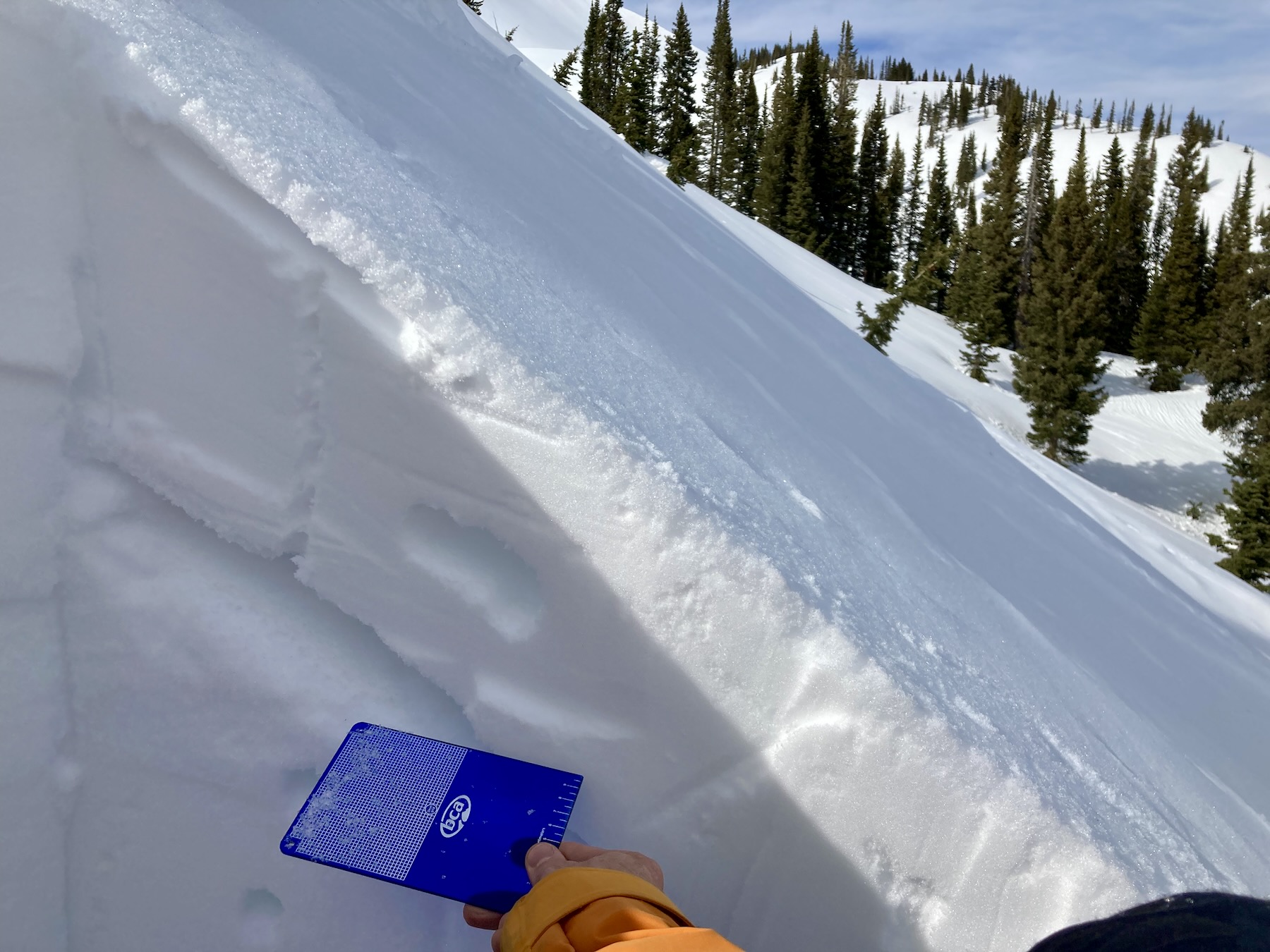
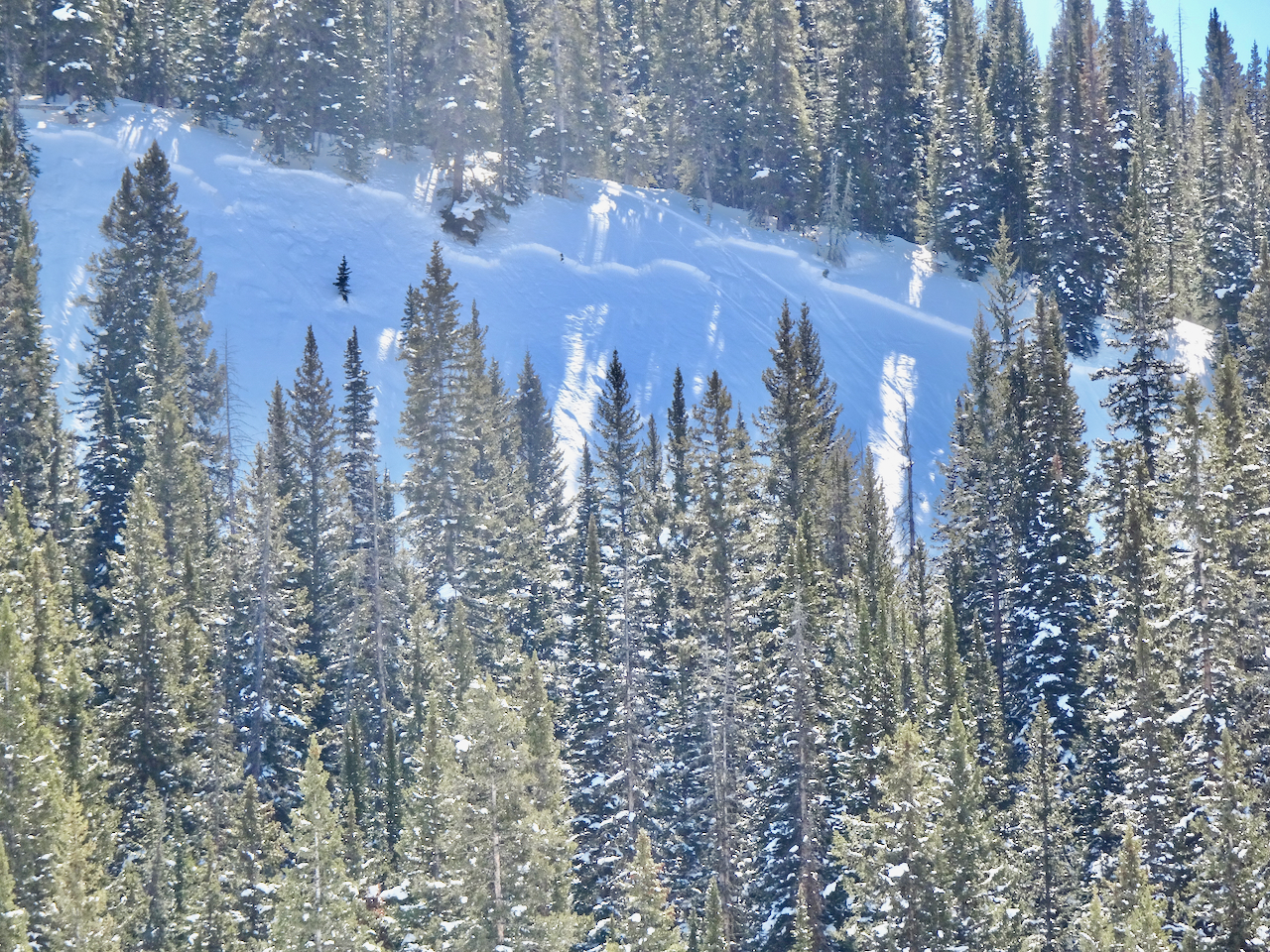
Snowpack: Snow surfaces got damp on all aspects that we traveled on, which spurred rollerballs and pinwheels on more northerly aspects which have stayed mostly dry all week. We looked at a number of NE-facing slopes that avalanched naturally during the last cycle. The previous avalanche activity did NOT flush out the facet layer; rather they just scraped off the top layer of the sandbox and left a thin bed surface crust in places. I expect repeat offenders on these slopes once slabs rebuild. We got several localized collapses (radiated about 10 or 15 feet) on low angle east and steeper northeast. We got a mix of easy propagating and non-propagating results with ECTs. Hard to find steep terrain around here that didn’t run naturally during the storm. On a steep ESE slope, the top 6″ is a stout melt-freeze crust and water has percolated through the sandbox. On a steep ENE slope, slabs were getting moist and/or there was some kind of thin surface crust, but the weak layer remained dry or could have been moist in some slopes.

Photos:

5453

Snow Surfaces Pre-Storm

CBACCBAC Observations

Date of Observation: 03/03/2022
Name: Evan Ross

Zone: Northwest Mountains
Route Description: Upper Slate River, many aspects between 9,600-11,300ft.

Observed avalanche activity: Yes
Avalanches: 1 loose wet avalanche on a west aspect above treeling. Otherwise nothing new and notable.

Weather: High clouds, hot temps, and calm wind.

Snowpack: The PSa problem felt stuborn with no obvious signs to instablity. Also no collapsing or obviouse signs to instablity traveling on the sunny half of the compass and in areas with a wet snowpack. I traveled on steep slopes, but not big slopes.

You have to get close to a north aspect to find a cold snow surface. Otherwise, the snow surfaces were wet. East and west aspects will have a notable crust, that crust will thicken of course as you head south around the compass. I didn’t find an area where water had drained to the February weak layer on east and west aspects, but there will still be a couple-inch thick crust on the current snow surface. Lots of water moving through the snowpack on SE to S to SW aspects and those will be locked up once they freeze again. This whole area looked like it would take a notable load before we see another widespread natural avalanche cycle. Mostly due to the thick crusts and the thick slabs, with the mid-February weak layer gaining some strength under those slabs over the last week.

Photos:

5450

Afternoon In The Wet

CBACCBAC Observations

Date of Observation: 03/02/2022
Name: Evan Ross

Zone: Northwest Mountains
Route Description: Washington Cultch, mostly southerly facing slopes BTL/NTL.

Observed avalanche activity: Yes
Avalanches: A couple of fresh slab avalanches off of Schuylkill Ridge. Both were D2 in size and released at 11,200ft. One released on a northeast aspect and the other an east aspect. I suspect there were triggered by loose snow avalanches coming off the rocks or sunny slopes above. As the avalanches ran they entrained wet snow.

Various loose wet avalanches that have run in recent days on steep sunny slopes. Nothing particularly notable.

Weather: Hot and sunny. Calm winds. A few clouds came through.

Snowpack: Looked in various locations on SE to W looking at the wet snow and if water was creating issues as it encountered the mid-February weak interface. In a quick summary, I didn’t end up finding a particularly concerning area where water was hitting or about to hit a dry weak layer. Surface cracks in the top couple inches of the snowpack were everywhere, similar to what you may see in the springtime as the snowpack is rapidly changing.

10,800ft on SE and SW. The recent round of water had made it to the mid-February interface and I didn’t find a particular slab concern. Water had previously drained below the mid-February interface and created various percolation columns below those crusts and into the larger grained melt forms or facets below. Of course, there is variation in snowpack structure based on slope angle, and how big their drainage is, such as concave slopes or slopes below cliff bands.

11,600ft, SE aspect, 30-degree slope. The water had made it to the mid-February crust and was running along the crust at this location. After the pit was dug you could see the water continuing to accumulate in the pit wall. In this location, water had also previously drained below the crust, earlier in the month, and into the larger grained facets. A CT test produced no results.

West between 10,200ft and 10,600ft. The upper 2 to 3″ of snow was wet. While the 1 to 2-foot slabs on the mid-February interface were dry with no water close to the interface. Addintally, traveling in this area at the end of last week I had encountered many collapses and shooting cracks. Now everything was quiet, but the snowpack structure still remained concerning for the PSa problem.

Photos:

5448

Avalanche inspections and wet snow conditions

CBACCBAC Observations

Date of Observation: 03/01/2022
Name: Ben Pritchett Eric Murrow

Zone: Northwest Mountains
Route Description: Keberl Pass corridor to snowbike avalanche slope near the Y and Red Lady Bowl in the afternoon

Observed avalanche activity: Yes
Avalanches: Inspected the previously reported avalanches near they Y and in Red Lady Bowl.
Weather: Ridgeline Wind Speed: Calm
Wind Loading: None
Temperature: 50 F
Sky Cover: Clear
Weather Description: Very warm day, full sun, no wind.
Snowpack: We found 1-finger hard slabs resting on Fist-hard facets. The slabs were soft on top, stiffer at the bottom, with an obvious dirt stripe above the faceted weak layer.
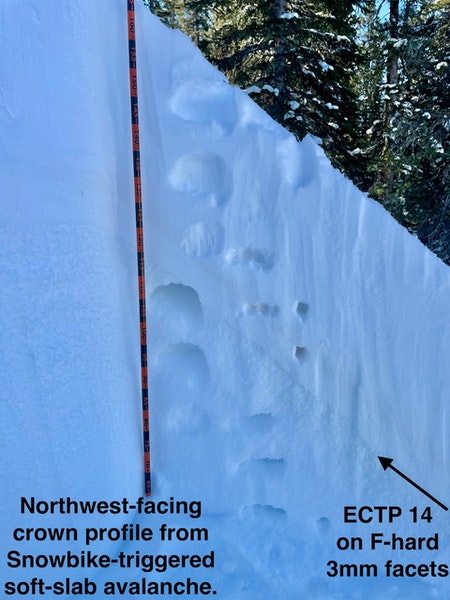
At a northwest-facing crown profile above a snowbike-triggered avalanche from Sunday, we found a reactive, dry snowpack. ECTP 14 on the dry-spell weak layer.
Traveling through sunny, southerly-facing terrain on Mt. Emmons, we experienced many dozen collapses with long-running (100’s of feet) cracks. Meltwater reached the dry-spell facets and created unstable conditions.
A profile on the flank of a large skier-triggered avalanche in Red Lady Bowl showed the meltwater reached the weak layer yesterday. Water wicked through the low-porosity facets. Today, meltwater reached another 10 to 12 inches below the facets into the upper part of the Holiday Slab.

Photos:

5444

Snodgrass shuffle

CBACCBAC Observations

Date of Observation: 02/28/2022
Name: Eric Murrow

Zone: Southeast Mountains
Route Description: Standard Snodgrass up-track and descended 3rd bowl area.

Observed avalanche activity: Yes
Avalanches: Lots of natural activity from the cycle last week. Most ran early in the storm with crowns well filled in and a few that ran towards the end. Many slopes greater than 35 degrees ran naturally, but not all start zones had evidence of recent avalanche activity. I suspect some features endured the loading event due to previous skier traffic. I skier-triggered a tiny loose avalanche on a steep, below treeline feature on southeast aspect at 1pm. Numerous small wet loose avalanches were visible on the east side of Gothic Mountains. They all began from rocky features; I’m uncertain if they occurred today or yesterday.
Weather: Clear skies and warm temperatures. Calm winds below treeline.
Snowpack: Southerly slopes soften before noon and I was able to produce a small wet loose avalanche at 1 pm. The top few inches were wet with couple inches of moist snow before the old crust.
On northerly terrain, I experienced a few moderately-sized collapses in low angle meadows. The slab resting above the February near surface facets was around 18″ thick and up to 1 finger hard. Two test profiles produced moderate propagating test results (ECTP 14,16). The weak layer is about 6 inches thick of fist hard 2mm facets. Signs of instability were less common than expected, but many lower angled slopes I traveled across appeared to have shattered during the loading event so that may have reduced the signs of instability. Surfaces hoar was present on N and NE slopes around 3-5mm in size.

Photos:

5438
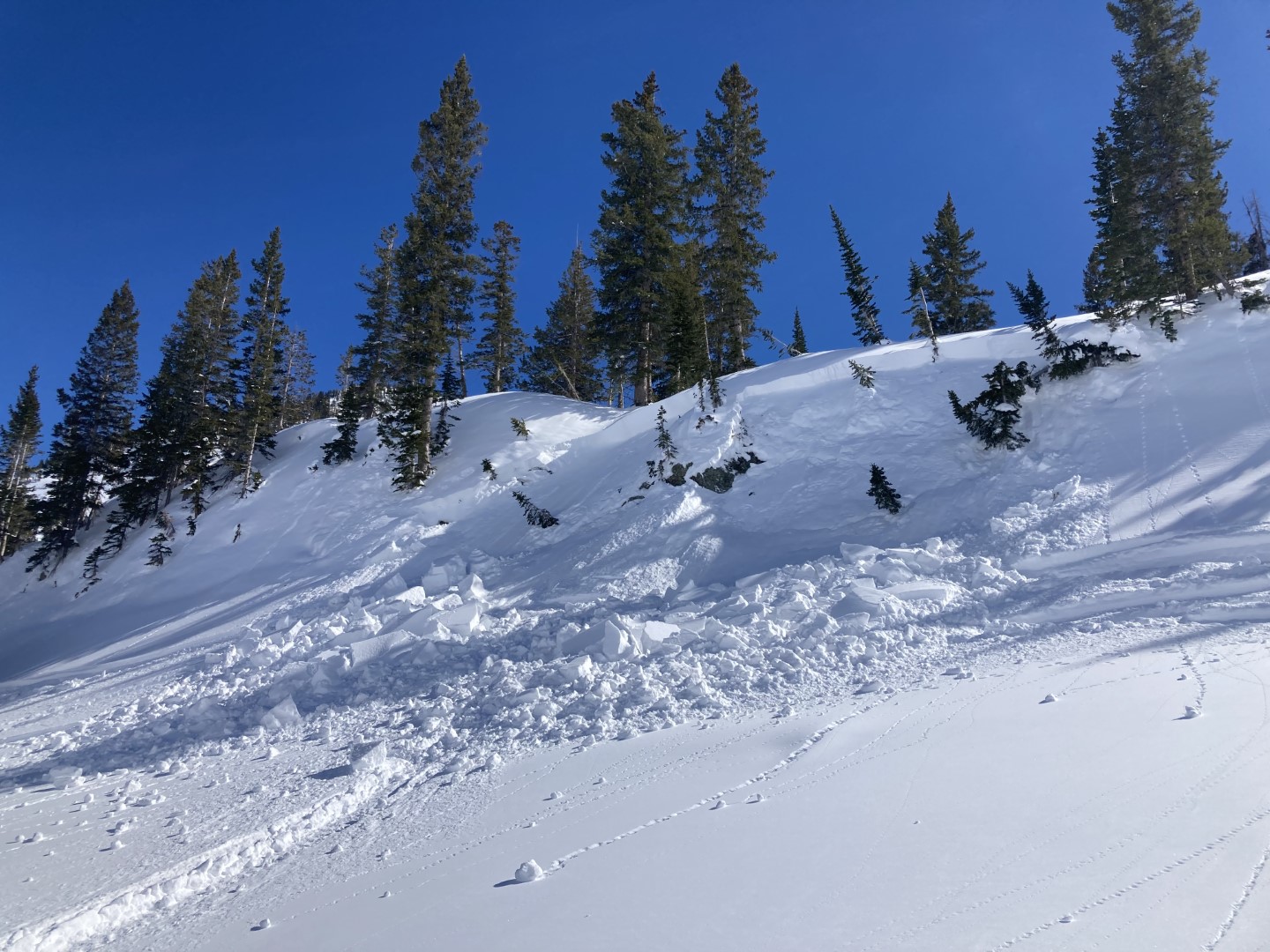
…and another large remote triggered slide.

CBACCBAC Observations

Date of Observation: 02/28/2022
Name: Zach Guy

Zone: Northwest Mountains
Route Description: Baxter Basin area. Traveled on various aspects to 11,500 ft.

Observed avalanche activity: Yes
Avalanches: A pair of snowmobilers riding tandem on one sled remotely triggered a large persistent slab on an east aspect near treeline. The associated crack wrapped about 900 feet around the terrain feature, but the slab only released about 200 feet wide. The slab was 70 cm thick, mostly F to 4F with about 8 cm of 1F near the bottom in the dust layer. The weak layer was…. you guessed it…the mid-February dry spell layer: 1 to 1.5 mm facets, fist+ hard. The snowmobilers triggered the slide after several passes adjacent to the slope and were not in harm’s way when it released.
We also intentionally triggered a couple of small slabs of similar thickness below treeline on small steep test features. A handful of D1 wet loose slides ran either today or yesterday at all elevations on E to SE to SW aspects.
Weather: Warm.
Snowpack: Obvious signs of instability were hit or miss without a particular rhyme or reason. We noted one rumbling collapse on an easterly aspect around 10,500 ft that shot cracks across some small supported rollovers without producing any slides. I noted a handful of other shooting cracks while riding around on lower angle terrain further down valley near Schuykill Ridge, and some of the steep rollovers that we tested produced cracking while more often they did not. Lots of large rollerballs on steep southerly aspects, surfaces on the sunbaked aspects were getting warm and wet.

Photos:

5437

Triggered slab in the trees

CBACCBAC Observations

Date of Observation: 02/27/2022
Name: Zach Guy

Zone: Northwest Mountains
Route Description: Near Irwin Townsite

Observed avalanche activity: Yes
Avalanches: Shared to CBAC on social media. Small skier triggered persistent slab in a small opening in west facing trees

Photos:

5435

Upper Cement Avalanches

CBACCBAC Observations

Date of Observation: 02/27/2022
Name: Zach Guy

Zone: Southeast Mountains
Route Description: Upper Cement Creek

Observed avalanche activity: Yes
Avalanches: Documenting slab activity from the cycle

Photos:

5433

More shooting cracks and remote triggering in Cement Creek

CBACCBAC Observations

Date of Observation: 02/27/2022
Name: Zach Guy

Zone: Southeast Mountains
Route Description: Snowmobiled on various aspects up Cement Creek to Double Top to Tilton Pass at 12,000 ft.

Observed avalanche activity: Yes
Avalanches: I remotely triggered a 16″ persistent slab on a west aspect near treeline from over a hundred yards away. Also remotely triggered a handful of very small pockets by creek beds. Observed one fresh cornice fall that produced a D1.5 avalanche. A couple of small loose wet slides ran this afternoon on steep south NTL.
Documented extensive D1 to D2 avalanche activity in the Southeast Mountains from the cycle, organized into separate obs by location. The most widespread activity was below treeline on W to N to E aspects with a lot of activity NTL on the same aspects. A couple of persistent slabs might have run today. Above treeline had the fewest slides, which makes sense because the faceted snow surfaces in the alpine in this area were heavily worked by winds prior to the storm, except for Cement Mtn. Above treeline had a handful of slides that failed on SE and S aspects as well.
Weather: Clear and calm. Cold start, mild day.
Snowpack: This area got the least amount of snow from the storm and the persistent slab problem is smaller and more manageable than what I’ve found in the Northwest Mountains. Slabs average about a foot thick: less than 10″ in Lower Cement, and up to 18″ near the headwaters, generally fist hard below treeline and up to 4F or 1F in driftier areas at higher elevations. The 2022 BS sandbox layer is as weak as ever here in sheltered terrain: 2-3 mm and fist hard. However, signs of instability are waning on northerly terrain below treeline because the slab is very soft and faceting over a soft weak layer. The bullseye for widespread shooting cracks was on east and west aspects where there is a thin crust helping drive propagation. I got moderate propagating results on this structure (ECTP11). Once I climbed into the most wind-affected terrain, signs of instability went away. The slabs are bonding well to pencil and knife hard wind blasted surfaces, with no results in tests or slope cuts.

Photos:

5432

Lower Cement Creek avalanches

CBACCBAC Observations

Date of Observation: 02/27/2022
Name: Zach Guy

Zone: Southeast Mountains
Route Description: Lower Cement Creek

Observed avalanche activity: Yes
Avalanches: Widespread soft slab cycle below treeline on W to N to E aspects, with a few wrapping into ESE. Mostly D1s except for longer running terrain produced D2s. Crowns are about 10″ to 12″ deep. A lot of activity on Cement Mountain as well, N and ATL up to D2. Photos show the most interesting slides, there were dozens more.
Weather:
Snowpack:

Photos:

5431