Near Miss on Teocalli

CB Avalanche CenterCBAC Observations

Date of Observation: 03/22/2022
Name: Whit Gilliam

Zone: Southeast Mountains
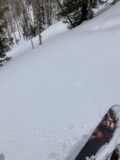
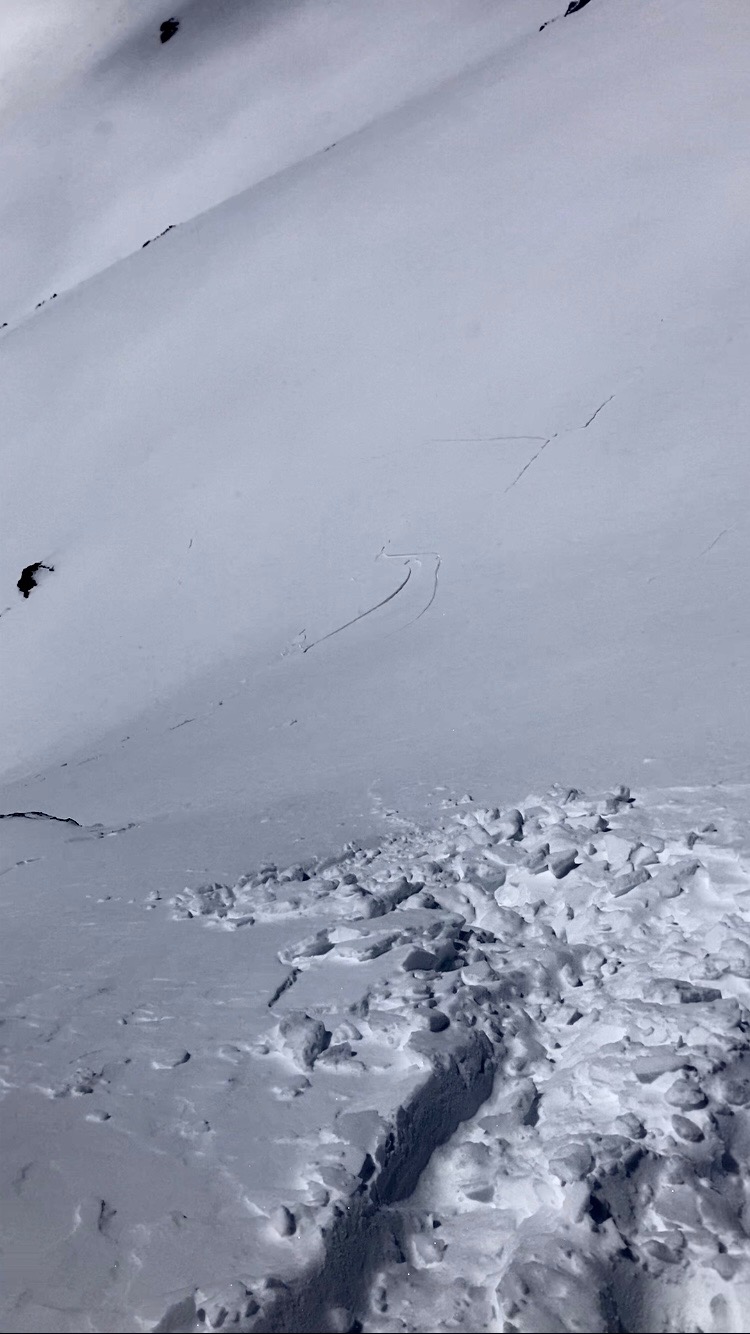
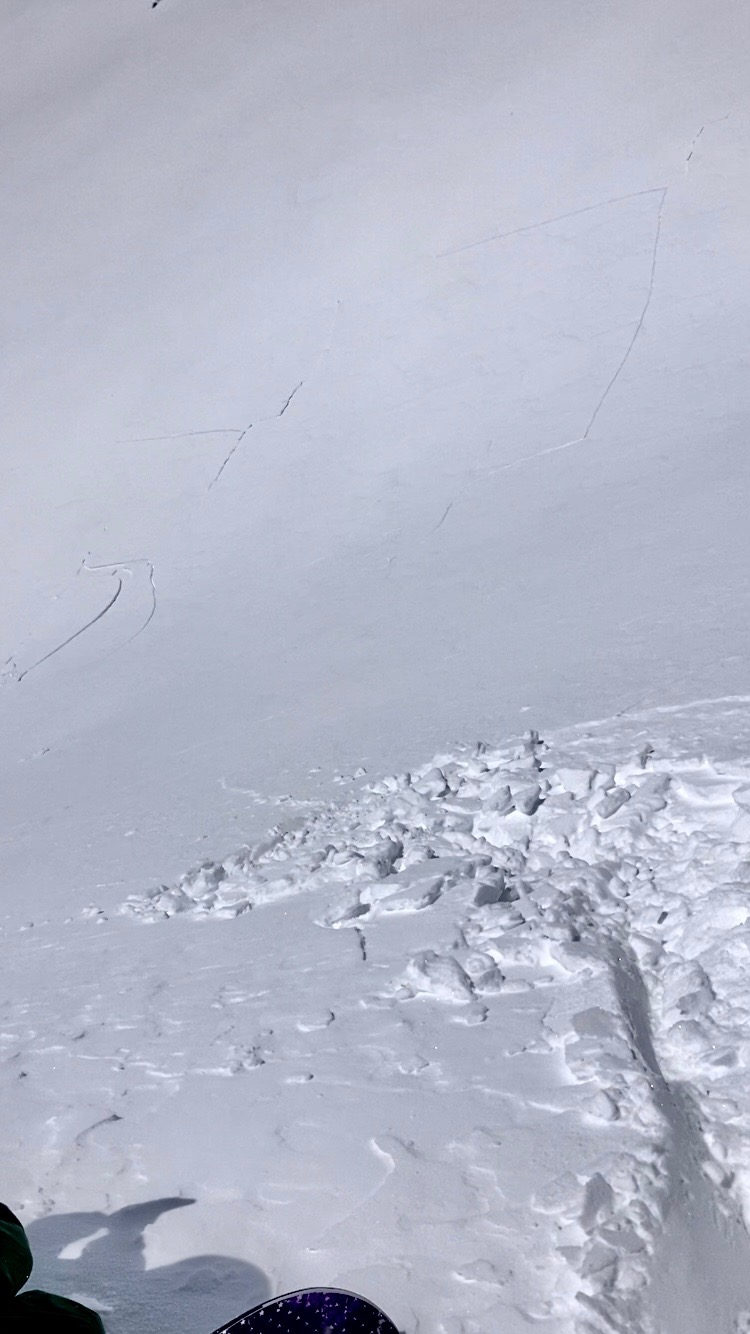
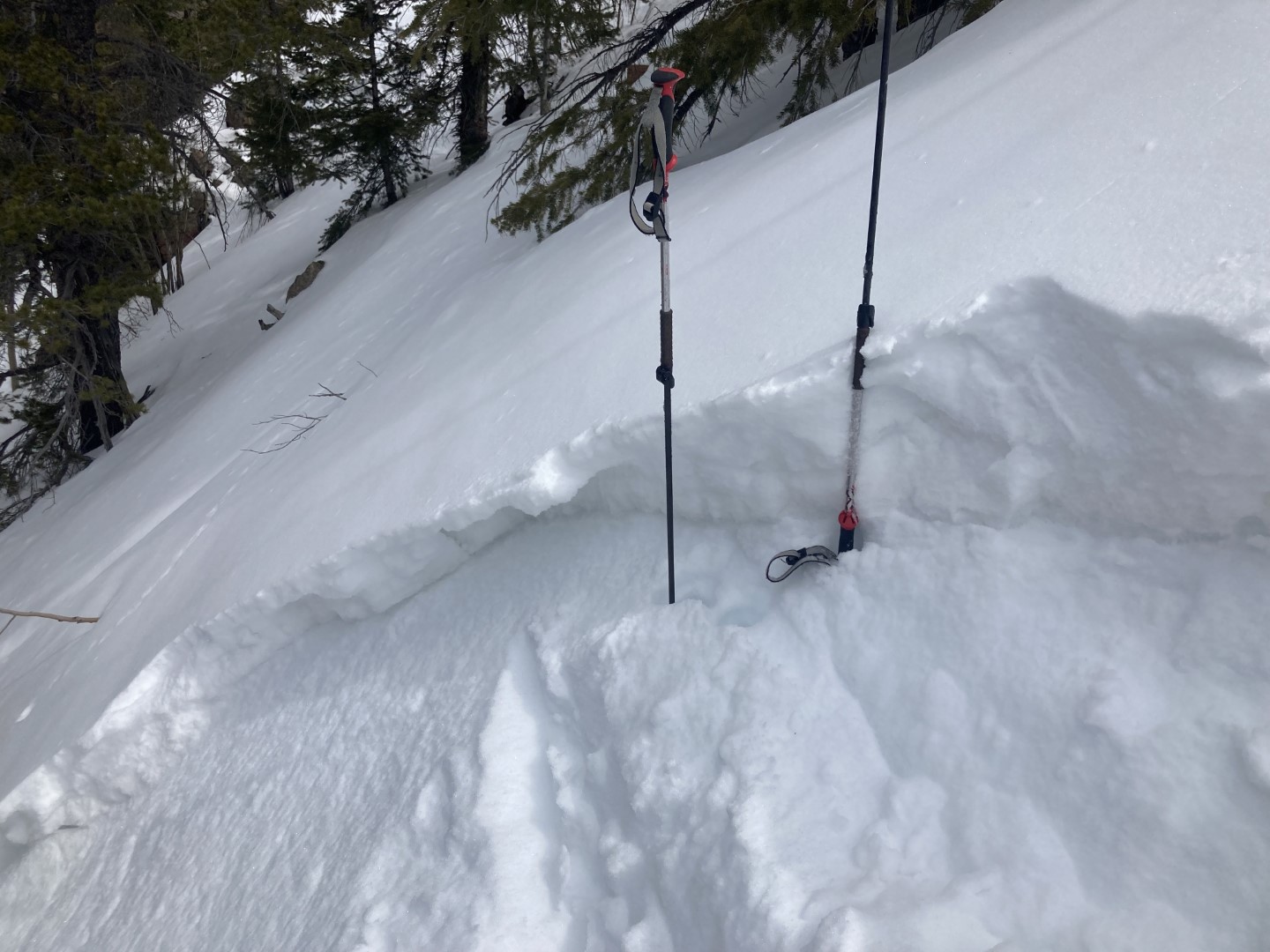
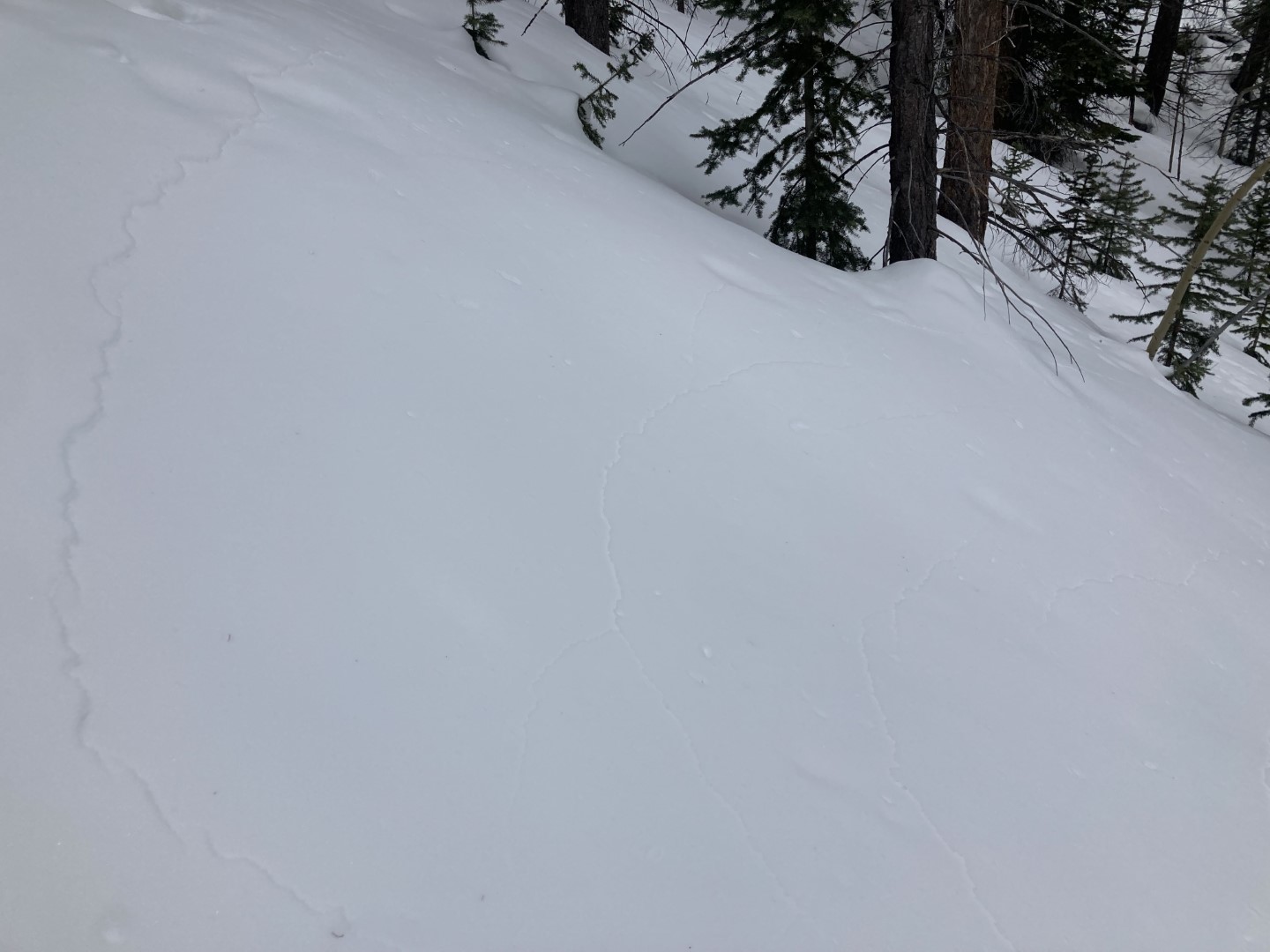
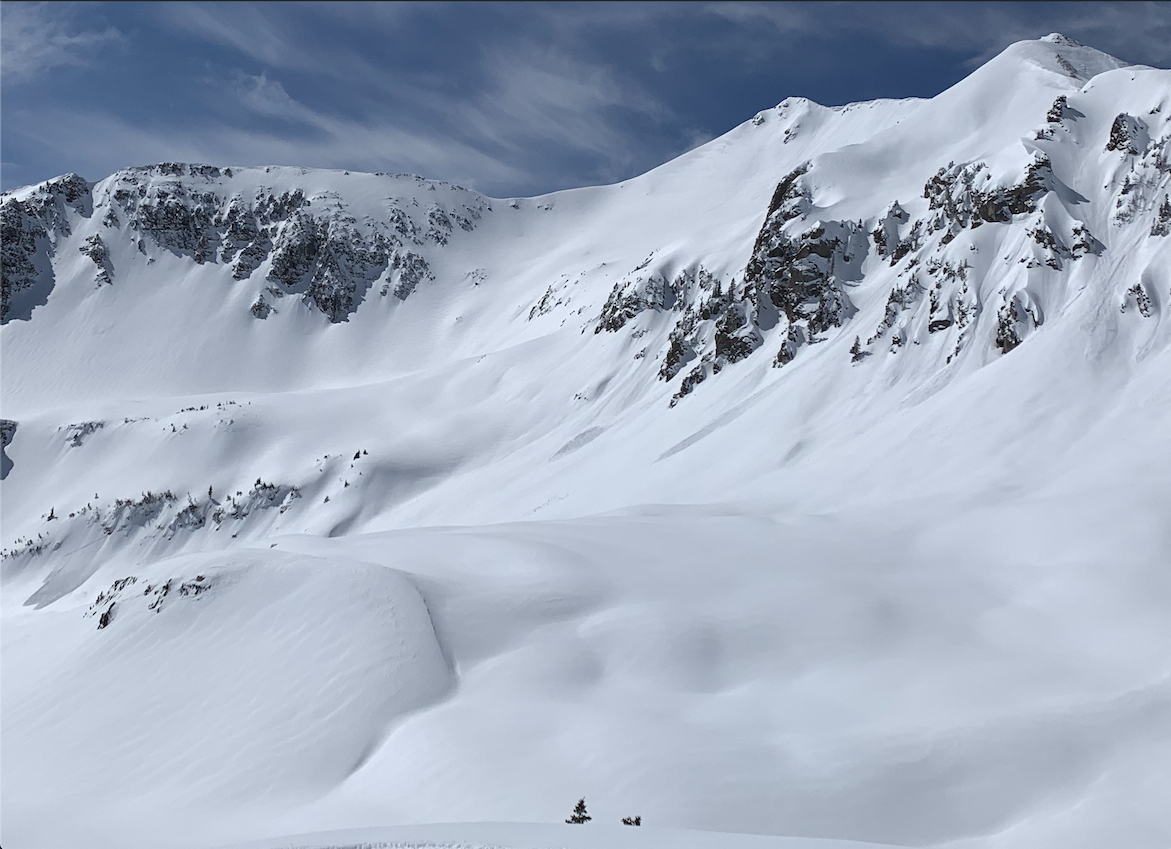
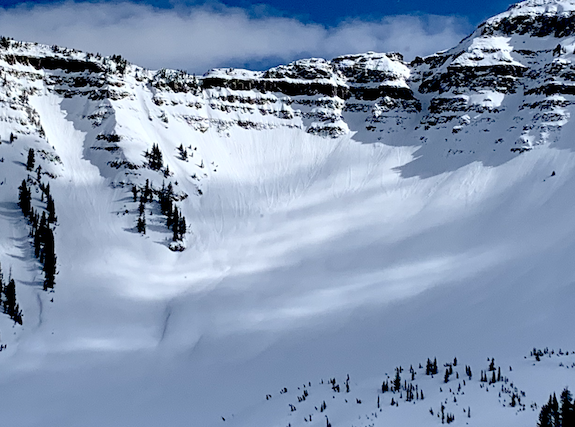
Route Description: Went up to ski N Teo, but the wind was crazy! Opted to stay lower on the South face and drop in. Picked a line above some small cliffs to sneak through to the lower main S face. I made one test turn on the edge of the slope we planned to ski and the whole face cracked all the way up! Slab was about 6″ thick, but hard to tell for sure, we didn’t hang around to check. Let’s just say we confirmed the forecasted wind slab on S faces! Thankful for this outcome!!!!!!

Observed avalanche activity: Yes
Avalanches: Wind slab, S, ~12,900ft, didn’t run
Weather: Windy as heck

Photos:

5502

Unstable test results

CBACCBAC Observations

Date of Observation: 03/21/2022
Name: Zach Guy

Zone: Northwest Mountains
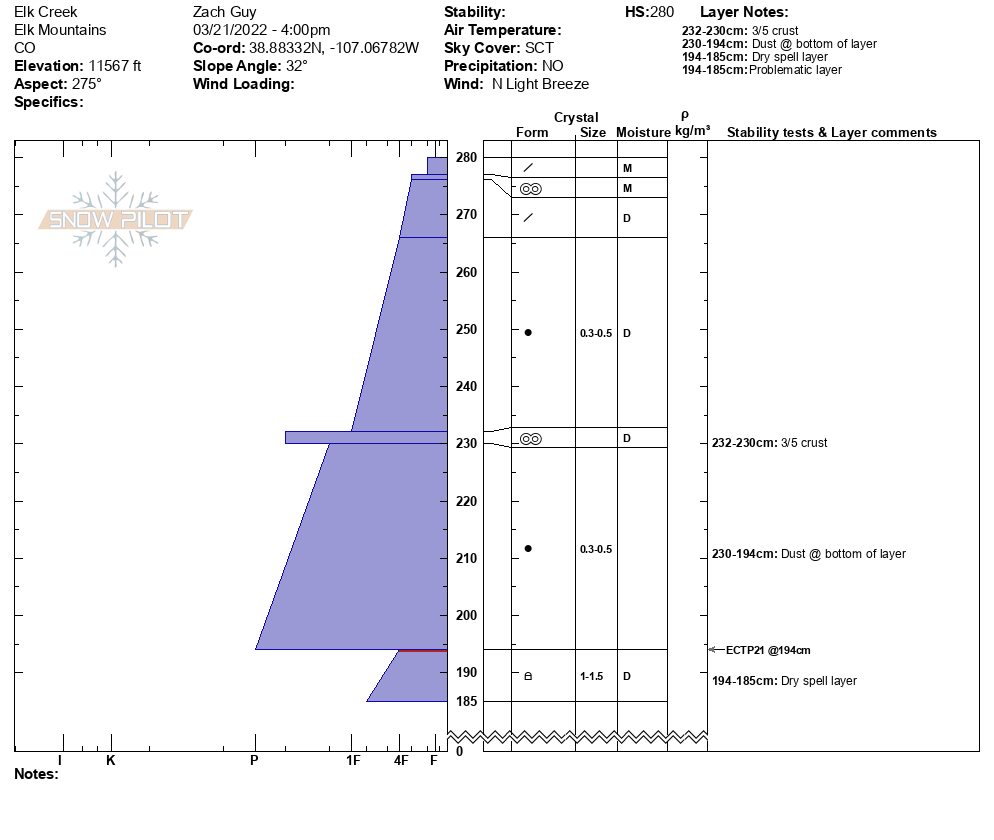
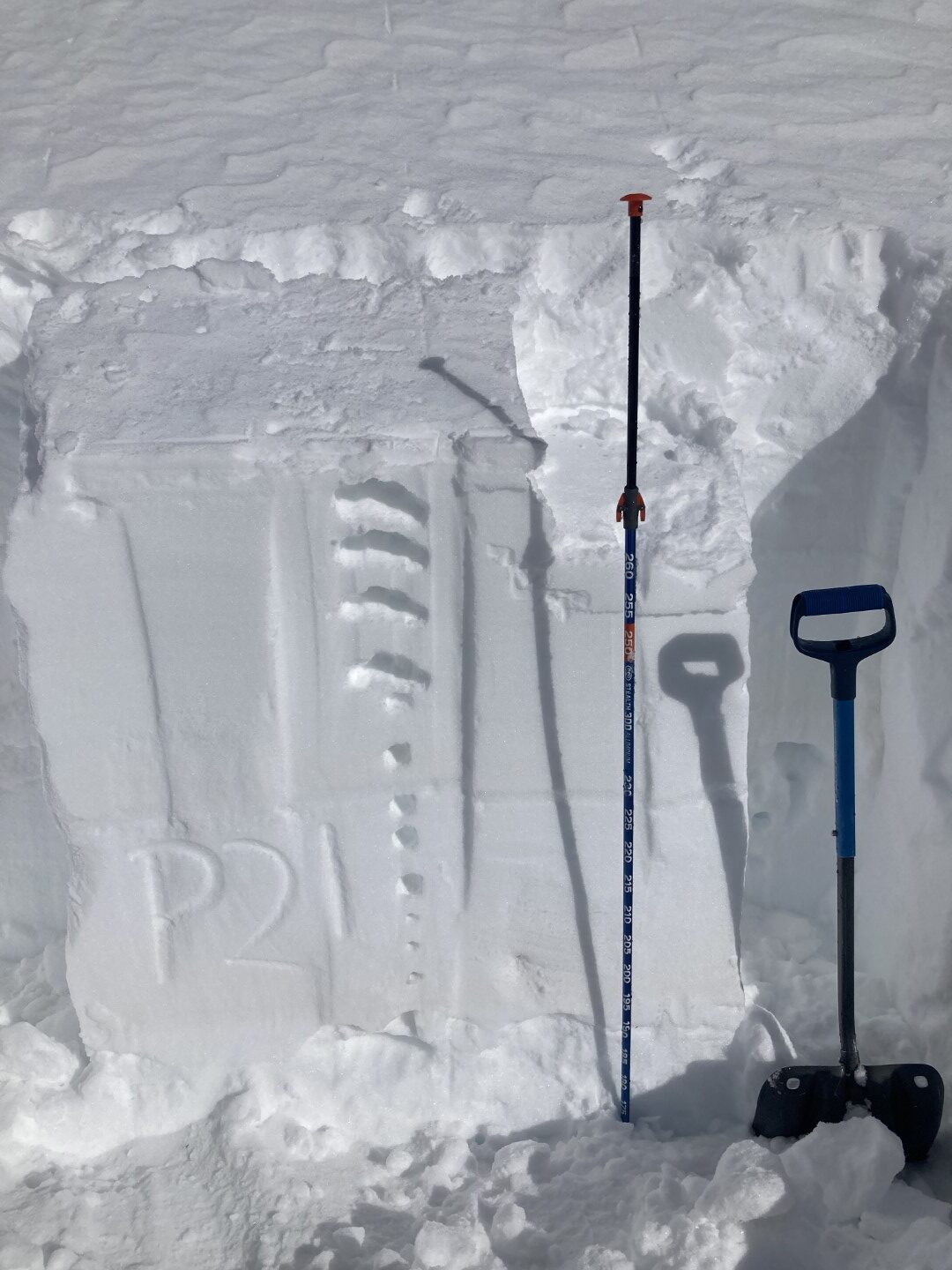
Route Description: Pit digging in Evans and Elk Creek basins checking in on our persistent slab problem and looking ahead to potential wet slab weather this weekend. I targeted pits near treeline on east, southeast, and west aspects.

Observed avalanche activity: No
Weather: Scattered to broken cloud cover. Light to moderate northerly winds with a little bit of blowing snow near ridgetop.
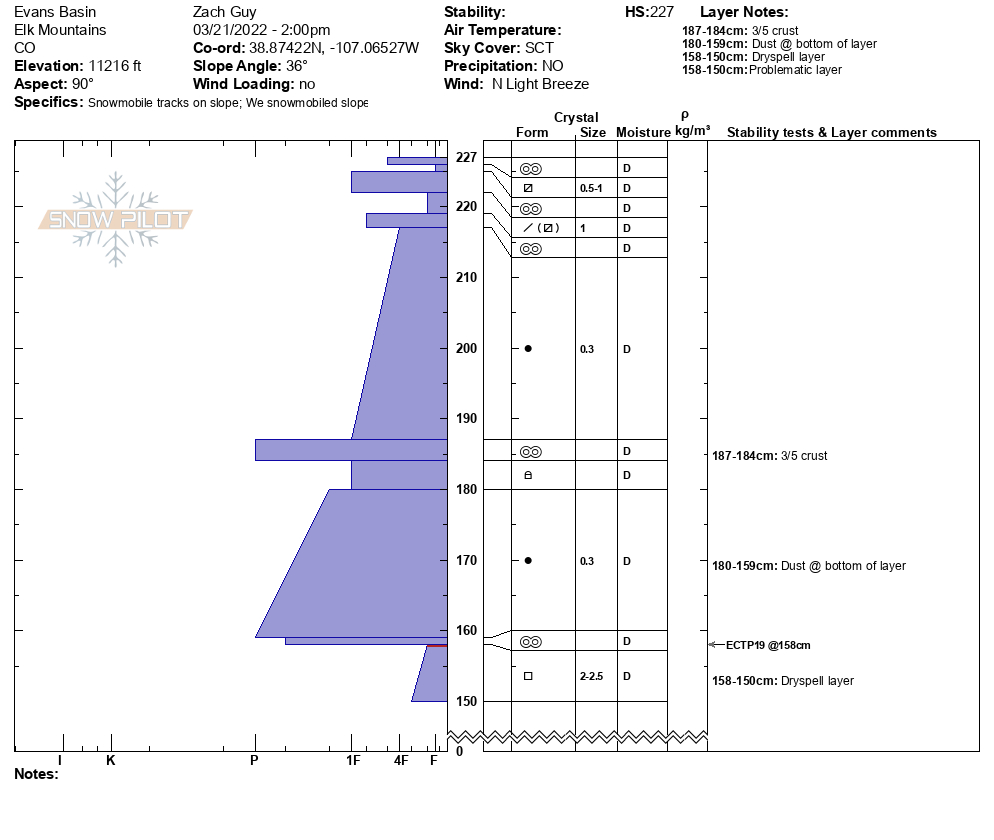
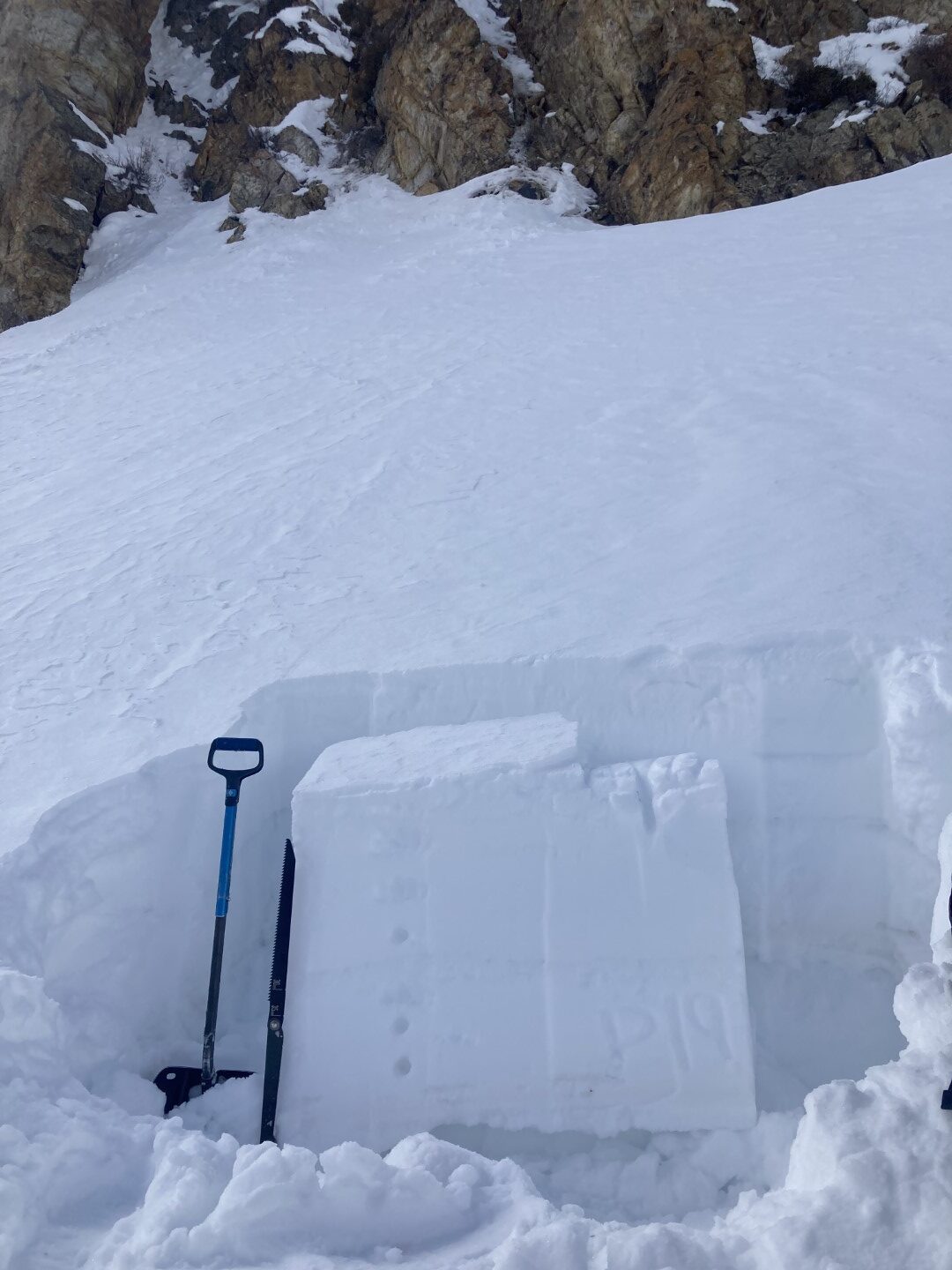
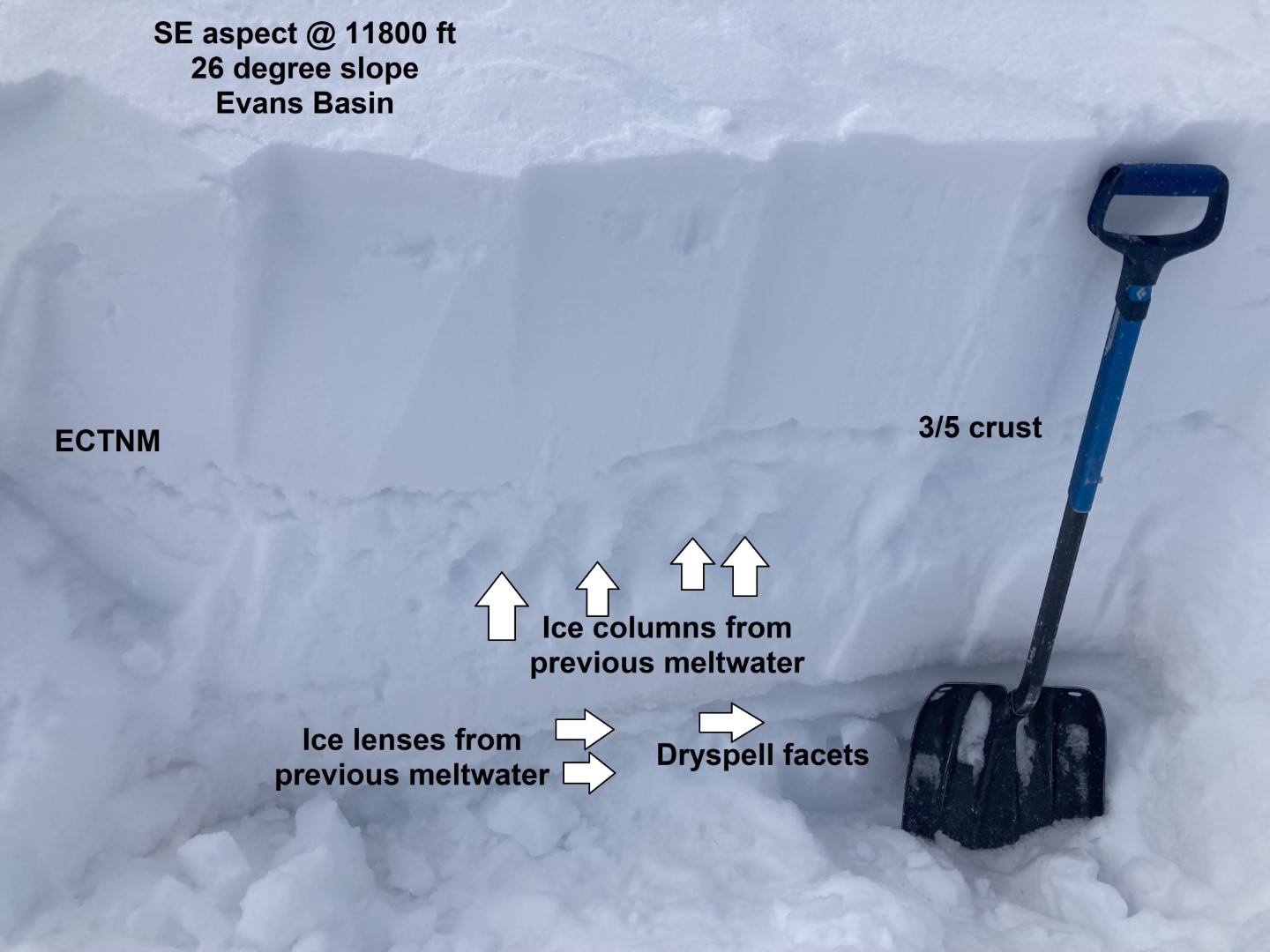
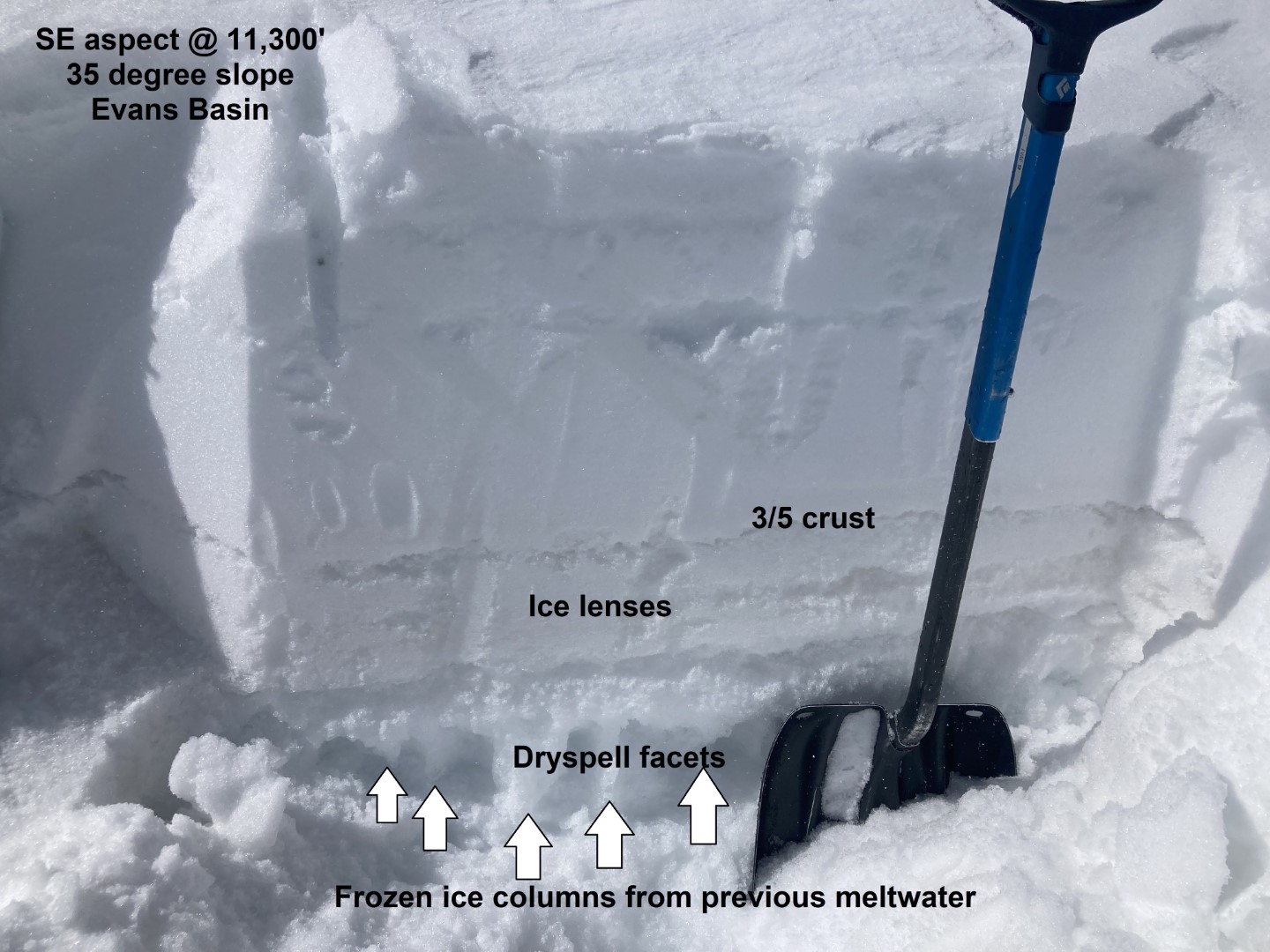
Snowpack: No signs of instability while sledding, but I got medium and hard propagating test results on east and west aspects, respectively, under 2 to 3-foot hard slabs. Where I dug on due east and due west aspects, the slabs and the dryspell sandbox layer have remained dry, apart from the 3/5 crust and some recent thin surface crusts (See profiles below).  Two pits on SE aspects and one on an ESE aspect showed frozen percolation columns and ice lenses below the 3/5 crust and in the sandbox layer. The upper half of the slab above the 3/5 crust has remained dry.
My biggest concern if we see a significant warmup later this week is on those transition aspects (east and west) if meltwater starts draining into the sandbox layer for the first time. With drainage already established through the layer on southeast aspects, that is less of a concern, at least where I dug. On those SE aspects, there may be potential for water to pool along the 3/5 crust and cause thinner wet slab issues, although I didn’t find an unstable structure above the crust that is particularly alarming (ECTN results).

Photos:

5501

Cement (aka Sandbox) Mountain

CBACCBAC Observations

Date of Observation: 03/20/2022
Name: Zach Guy

Zone: Southeast Mountains
Route Description: Traveled on West to North aspects below treeline on Cement Mountain, up to 10,500 ft.  This is one of the shallowest parts of our forecast area.

Observed avalanche activity: Yes
Avalanches: Ski cut a small persistent slab on a small terrain feature facing NW. The slab was just under a foot thick and failed on the mid-February facets.
Weather: Thin overcast and mild temps made for good greenhousing midday, which moistened surfaces on northerly aspects. No wind where I traveled, but I could hear it higher up.
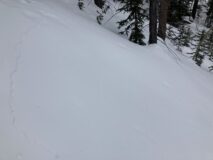
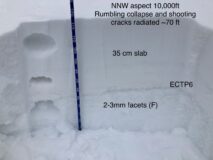
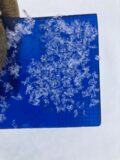
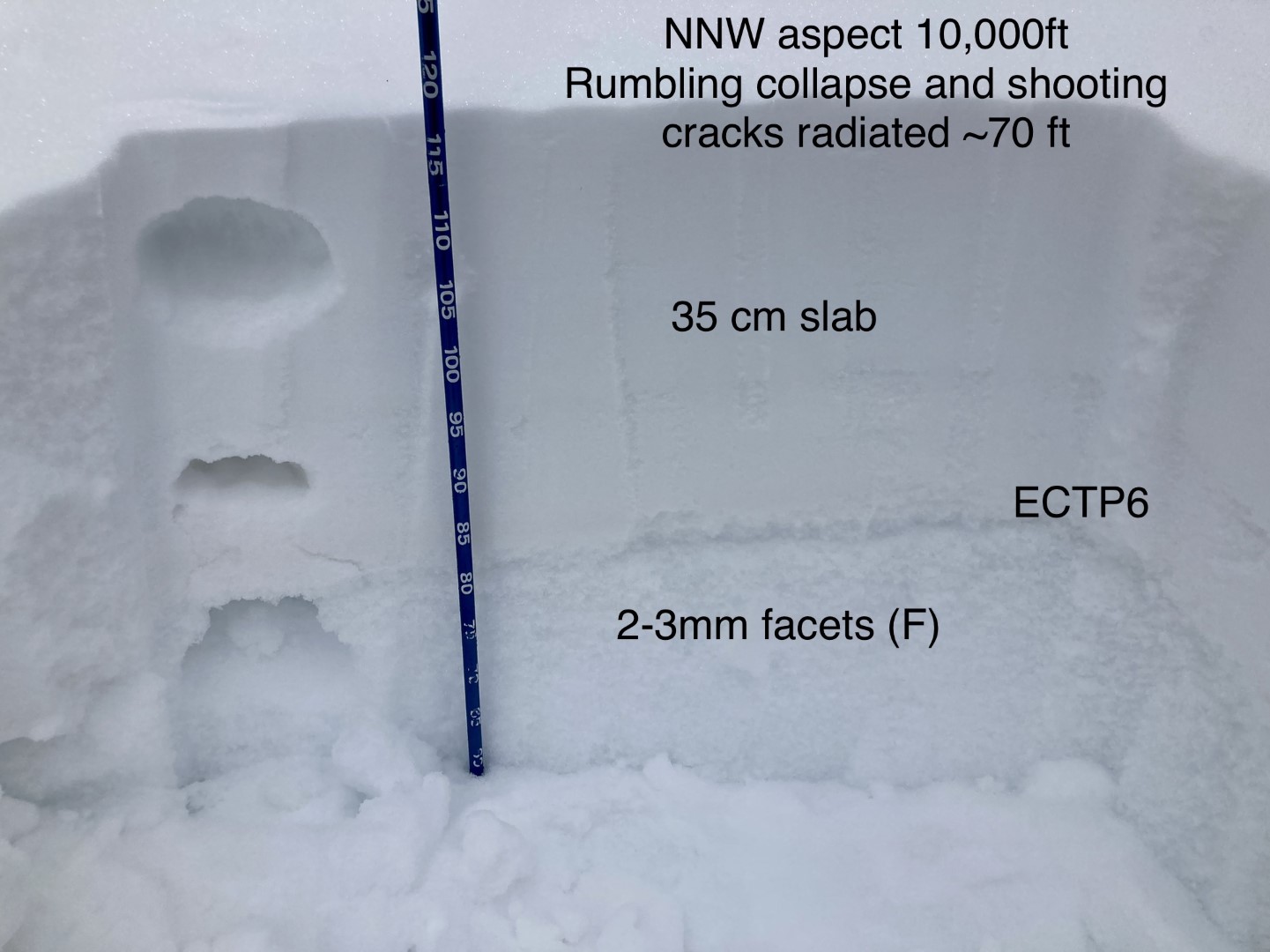
Snowpack: On northerly tilted aspects, the mid-February “sandbox” layer is uniformly weak and lousy; the key ingredient for instabilities here is the presence of a slab. At the lowest elevations, below about 9,700 ft, the slab is thinner and faceted out with ski pen consistently going through an unsupportive upper snowpack. I got numerous collapses, but cracks would only propagate 5 or 10 feet at most. As I gained elevation, the upper snowpack became more supportive and slabs were a bit thicker and denser (about 35 cm, 4F). I got widespread collapsing and shooting cracks, typically radiating 20 to 50 feet, and a couple up to 100 ft. Stability tests produced easy propagating results on the sandbox layer, which is 2-3 mm in size and fist hard. HS averaged 80 to 120 cm. The two pronounced start zones that I traveled near had already avalanched back in late February and the upper snowpack was all faceted on those terrain features with no concerns.
Snow surfaces got moist on northerly aspects and I skier triggered numerous rollerballs and pinwheels, but nothing gained enough volume to turn into a wet loose slide.

Photos:

5500
Hunter Creek

CB Avalanche CenterCBAC Observations

Date of Observation: 03/20/2022
Name: Ben Pritchett

Zone: Southeast Mountains
Route Description: Hunter Creek

Observed avalanche activity: No
Avalanches: We saw no recent avalanches other than some minor loose shedding out of very steep rocky slopes.

Weather: Chilly start with quick warm up late morning. Scattered high-thin clouds.

Snowpack: We found an average snowpack depth around 200cm in wind-sheltered terrain near treeline. Above treeline the snowpack is highly variable with many wind-swept areas only 100-150cm deep.
Surprisingly we only experienced one booming collapse on slab that was softer in the afternoon than when we travelled over it during the morning. This occurred with two sleds close together on a westerly-facing slope around 2:30pm. The slope was just too low angle to avalanche. Otherwise the snowpack stayed eerily quiet all day.
Snow surfaces moistened below 10,000′, but we found no fresh meltwater at the snow surface at upper elevations.

5498

Remotely triggered Persistent Slab, Wet Slab, and shallow Wind Slabs

CBACCBAC Observations

Date of Observation: 03/18/2022
Name: Eric Murrow Ben Pritchett

Zone: Northwest Mountains
Route Description: Kebler Pass area. Mount Owen in the Ruby Range and Kebler Pass Road corridor.

Observed avalanche activity: Yes
Weather: A mix of sun and thin high and mid-level cloud cover. Temps slightly above freezing at valley bottom and below freezing temps on Mount Owen.
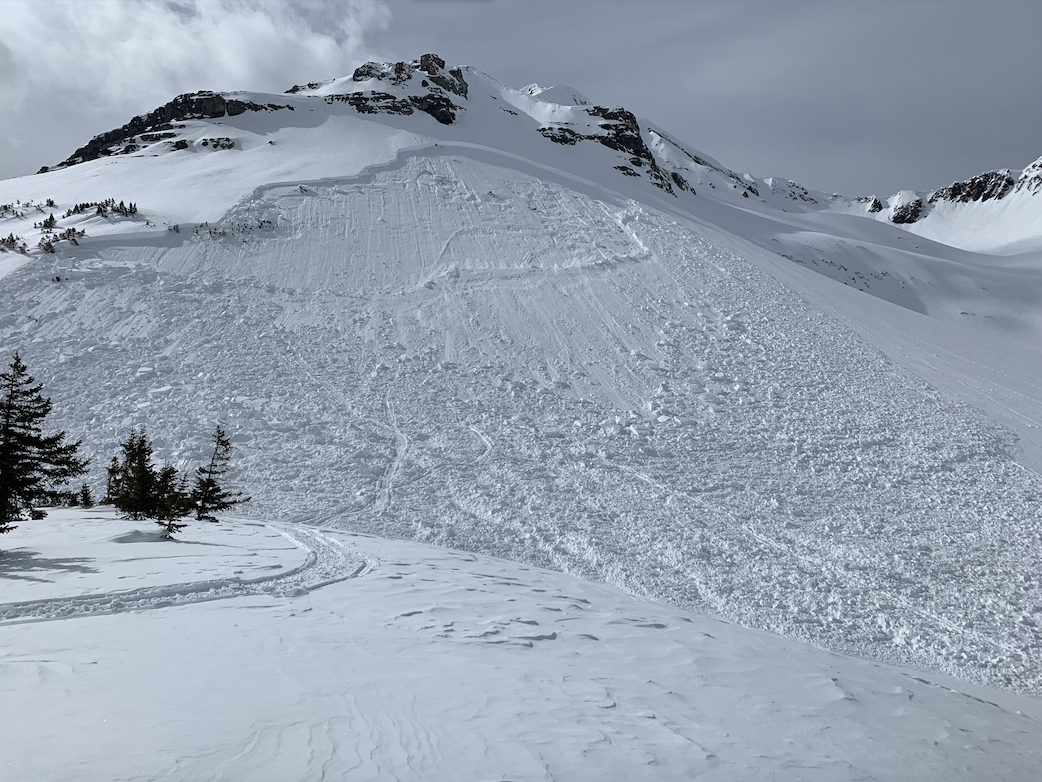
Snowpack: We traveled out to Mount Owen to inspect an avalanche that was reported to run at 11am on an east slope of Mount Owen. Investigating this slide it appeared that a group of snowmobilers/snowboarders likely triggered this avalanche remotely from low angled terrain around 600 feet away. It failed in the February facet layer; the slab ranged from around 50cm to 110cm thick (estimated as we did not measure across the entire crown face). The slab and the slope were shallower than expected based on snowfall totals this winter for the Irwin area. This avalanche was large in size (D2) and could have easily buried a person.

Late in the afternoon, an avalanche was reported to hit Kebler Pass Road. This avalanche was a Wet Slab that was likely remotely-triggered by a snowbike based on a nearby snowbike track. This avalanche failed in the February facets as well, and they were wet from meltwater when the crown was inspected.

Avalanches: In addition to the remotely triggered Persistent Slab on an east aspect above treeline on Mount Owen, the Wet Slab on an east aspect below treeline above Kebler Pass Road, we observed two fresh snowboarder-triggered slabs in the recent storm snow. Both were only a few inches thick and small in size.

Photos:

5496

Snowbelt observation from the Ruby Range

CBACCBAC Observations

Date of Observation: 03/17/2022
Name: Eric Murrow Ben Prichett

Zone: Northwest Mountains
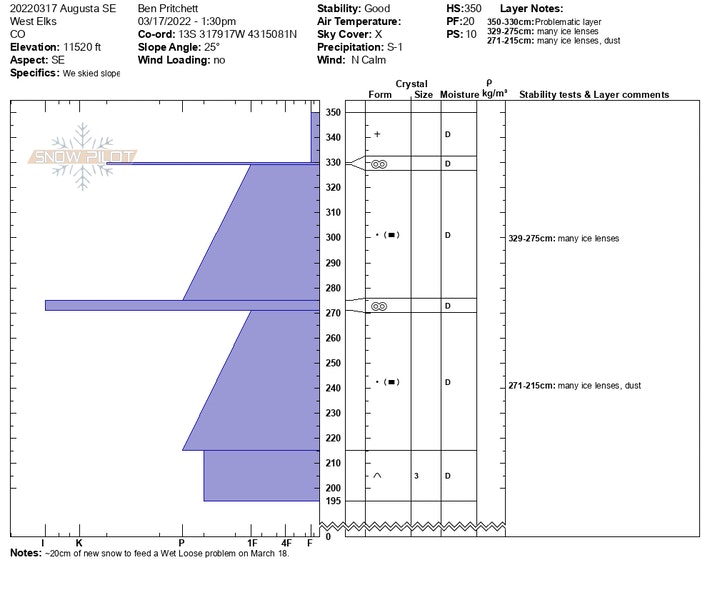
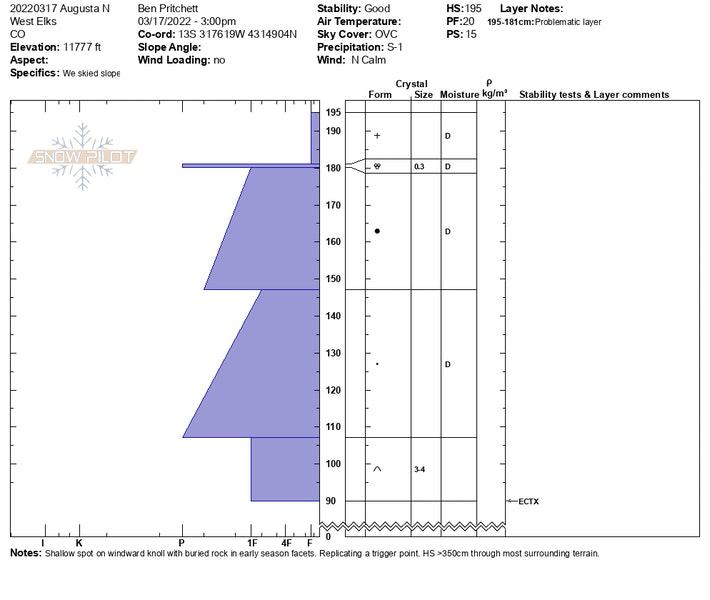
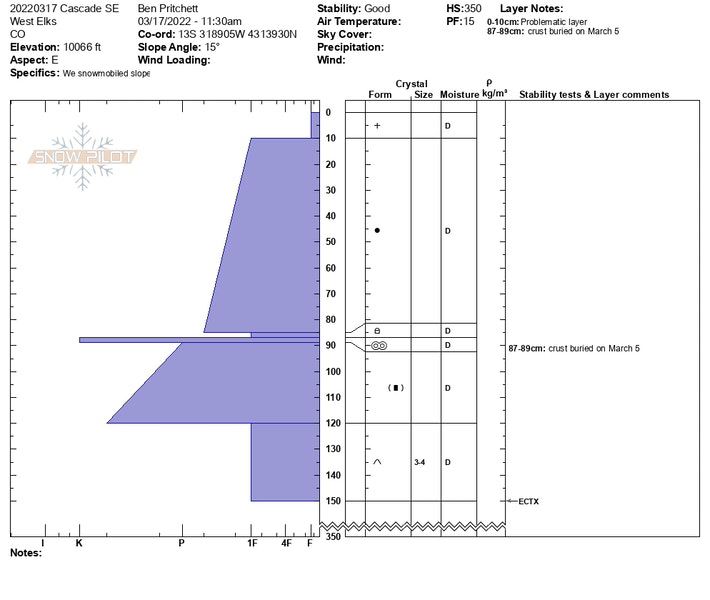
Route Description: Cascade and Augusta Mountain area along the spine of the Ruby Range. Slate River corridor to Poverty Gulch and traveled on foot around the Angel Pass area.

Observed avalanche activity: Yes
Avalanches: Numerous loose avalanches in the storm snow around rocky areas near and above treeline. Several shallow slab avalanches in the storm snow were observed at upper elevations. All the fresh avalanche activity was small in size and generally not a threat to a person
Weather: New snow accumulations overnight ranged from 2 inches at valley bottom to 6 inches above treeline. Cloud cover alternated between overcast and broken. Light snowfall during the early afternoon hours.
Snowpack: In this snow-favored area, the snowpack was commonly near or deeper than 300cm. We dug several profiles on southeast, east, and north slopes assessing the Persistent Slab structure (see profiles). The profile from the northerly slope was in an abnormally shallow area as we looking for a “trigger point” type location where it would be more likely for the weight of a person to impact the weak layer. On the north half of the compass, the concerning February weak layer was generally 150+cm deep and 1 finger hard, no notable snowpack test results. No signs of instability were noted on the deeply buried weak layers.

Photos:

5495

Gothic 7am weather update

CBACCBAC Observations

Date of Observation: 03/17/2022
Name: Billy Barr

Zone: Southeast Mountains
Route Description: Gothic townsite

Observed avalanche activity: No
Weather: Cloudy, windy and mild with only very light, intermittent snow so just 1″ new and water 0.09″. Currently overcast with steady 5-10 mph W wind with the temperature 19F, also the days low. The snowpack is at 60½”, right around the average for this time of year. billy

5494

Looking at the Peristent Slab problem where the slab is thin

CBACCBAC Observations

Date of Observation: 03/16/2022
Name: Eric Murrow

Zone: Southeast Mountains
Route Description: Lower Snodgrass above the East River.

Observed avalanche activity: No
Avalanches: Did not observe any new avalanches.
Weather: Increasing cloud cover throughout the day. Light winds with mild air temperatures.
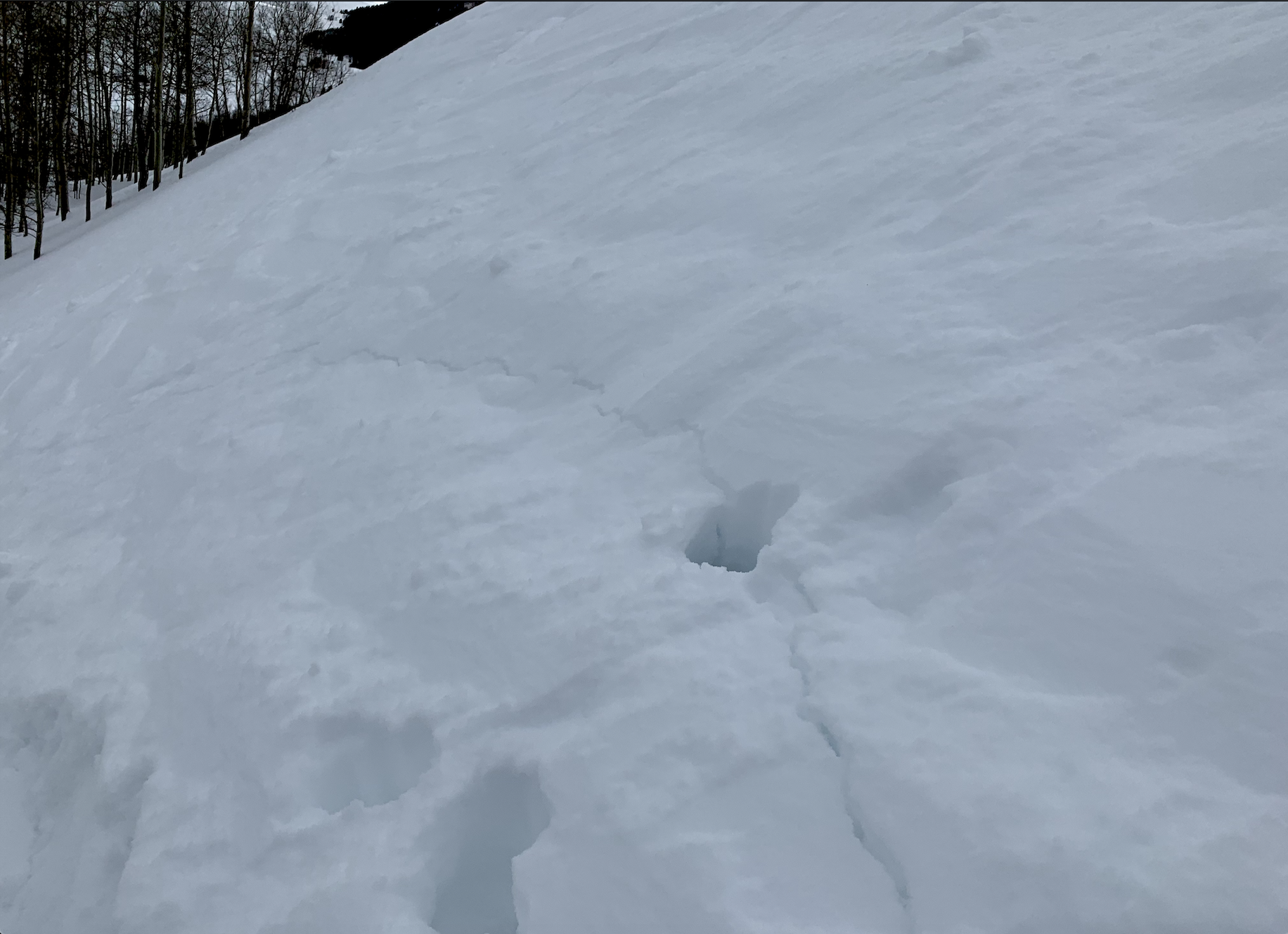
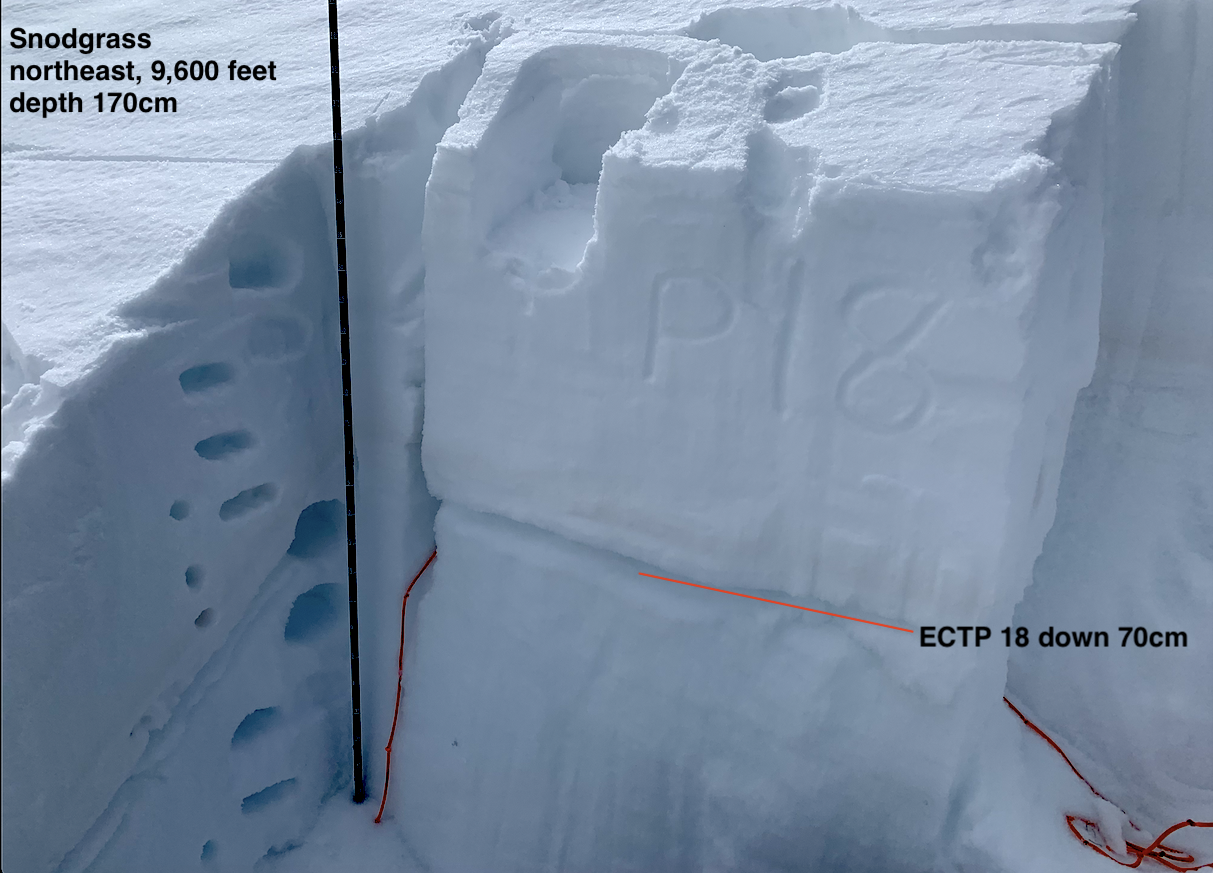
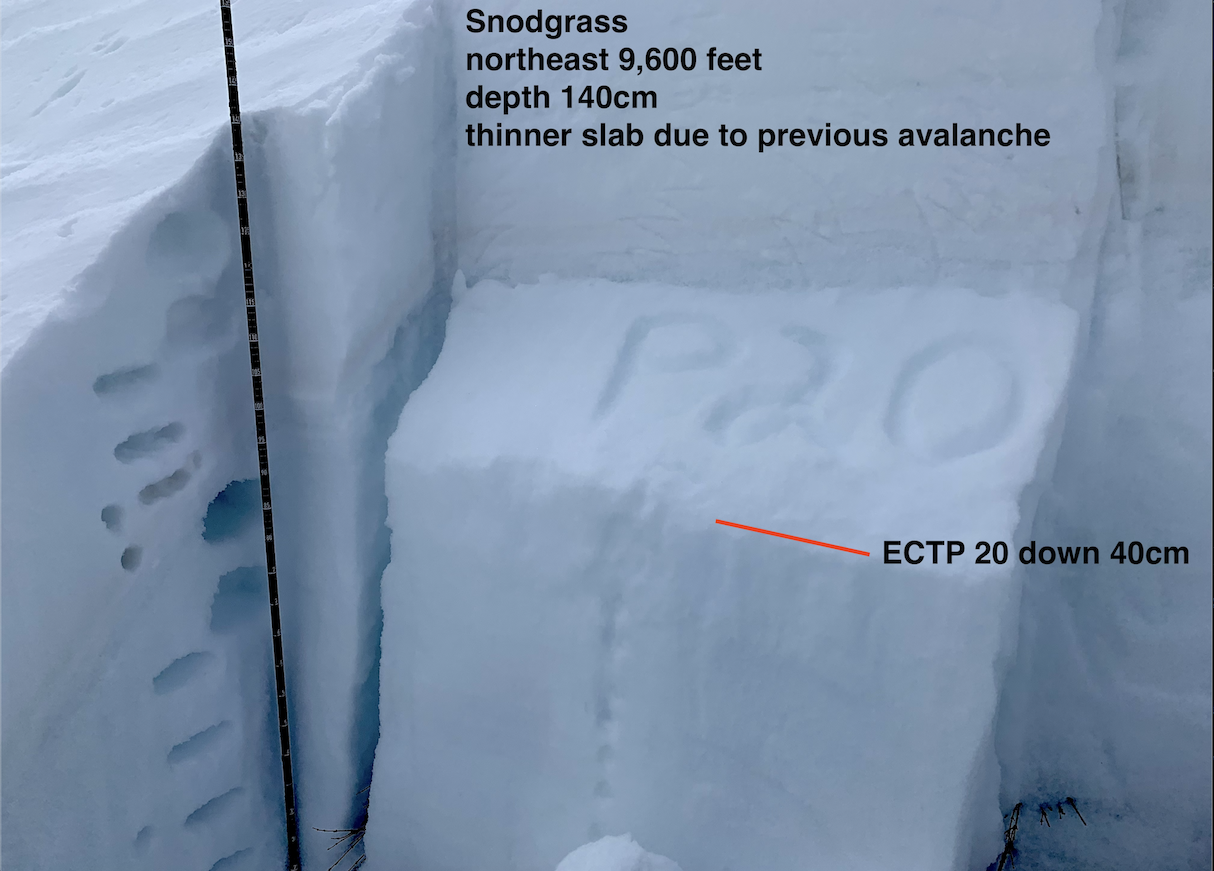
Snowpack: I went looking for signs of instability in terrain where the Persistent Slab problem has a thin slab and a weak layer that is not improving (shady slopes with a relatively shallow snowpack). I was able to get a few small collapses and shooting cracks up to 20 feet on a slope with previous avalanche activity. This slope had reformed a slab 40cm thick (a bit more than a foot) resting over the February facet layer. Stability tests on this slope and an adjacent slope, that has not avalanche (slab around 70cm thick), produced propagating results under moderate force. Obvious signs of instability are decreasing, BUT stability tests and upper snowpack structure on shaded slopes suggest that human triggered avalanches remain possible. The snow surface on all aspects below around 9,800 feet became moist in the afternoon.

Photos:

5493

The 48th Annual Al Johnson

CBACAnnouncements, Backcountry Notes, Events, News

The 48th Annual Al Johnson Uphill/Downhill Memorial Telemark Ski Race is this Saturday, March 19. Registration can be completed online at www.eventbrite.com/e/al-johnson-memorial-telemark-race-2022-registration-291459813147?aff=ebdssbdestsearch or the day of the race 8-10 a.m. at the check-in & bib pick-up in the Adventure Center in Mountaineer Square. $50 lift tickets for competitors without a pass will be available at the Adventure Center during check-in. A portion of the proceeds go the the CBAC.
Don’t know what telemark skiing is? Check this out!


Ski Telemark from Curtis Johns on Vimeo.

Rider-triggered avalanche visit

CBACCBAC Observations

Date of Observation: 03/14/2022
Name: Zach Kinler and Ben Pritchett

Zone: Northwest Mountains
Route Description: Kebler Pass trailhead to Elk Creek

Observed avalanche activity: No
Avalanches: Site visit to document the recent rider-triggered avalanche, no new avalanches observed
Weather: Sunny and warm, finally felt like March. Calm winds below tree line and abundant sunshine with temps near to above freezing.
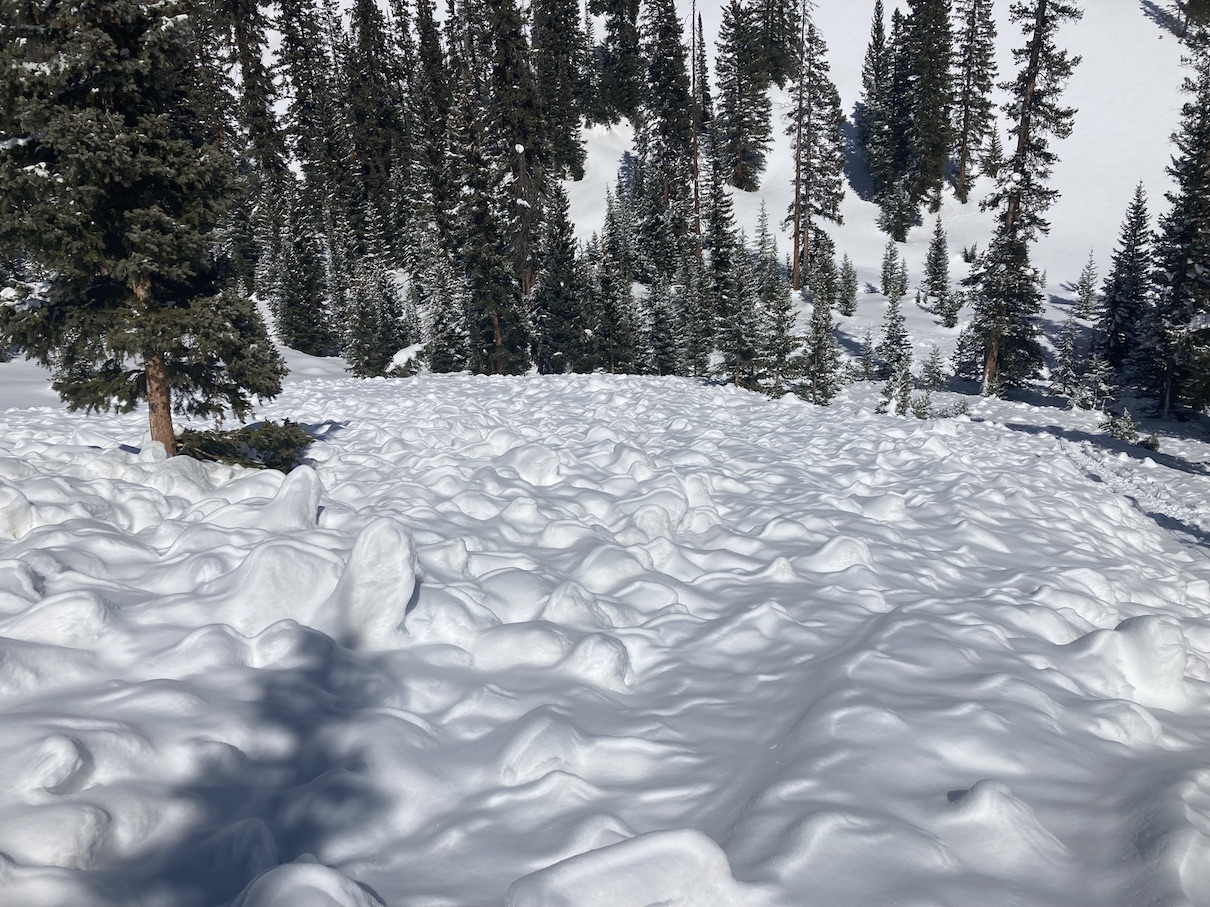
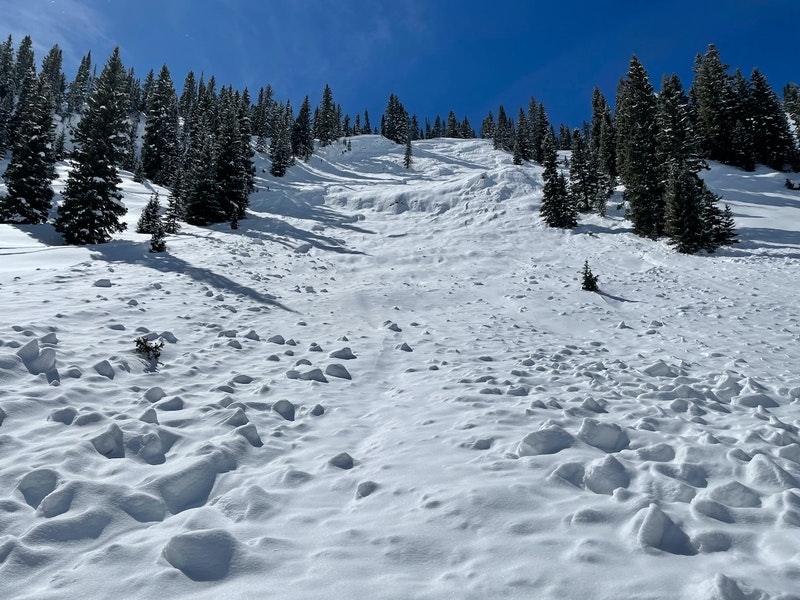
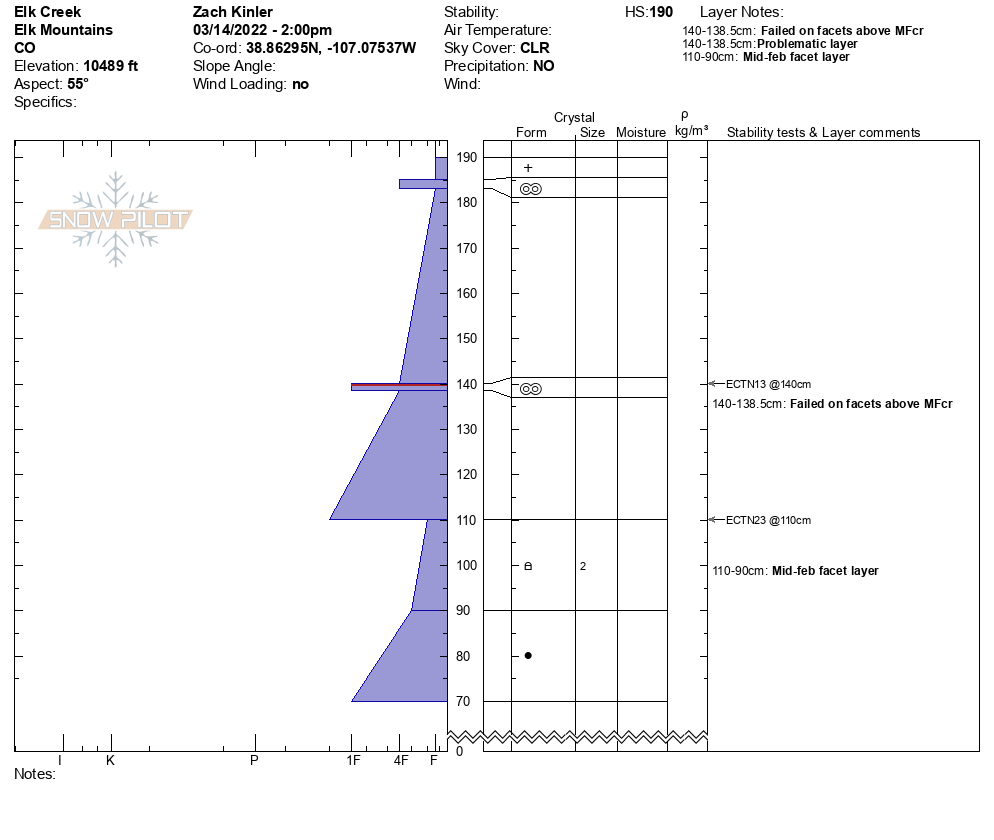
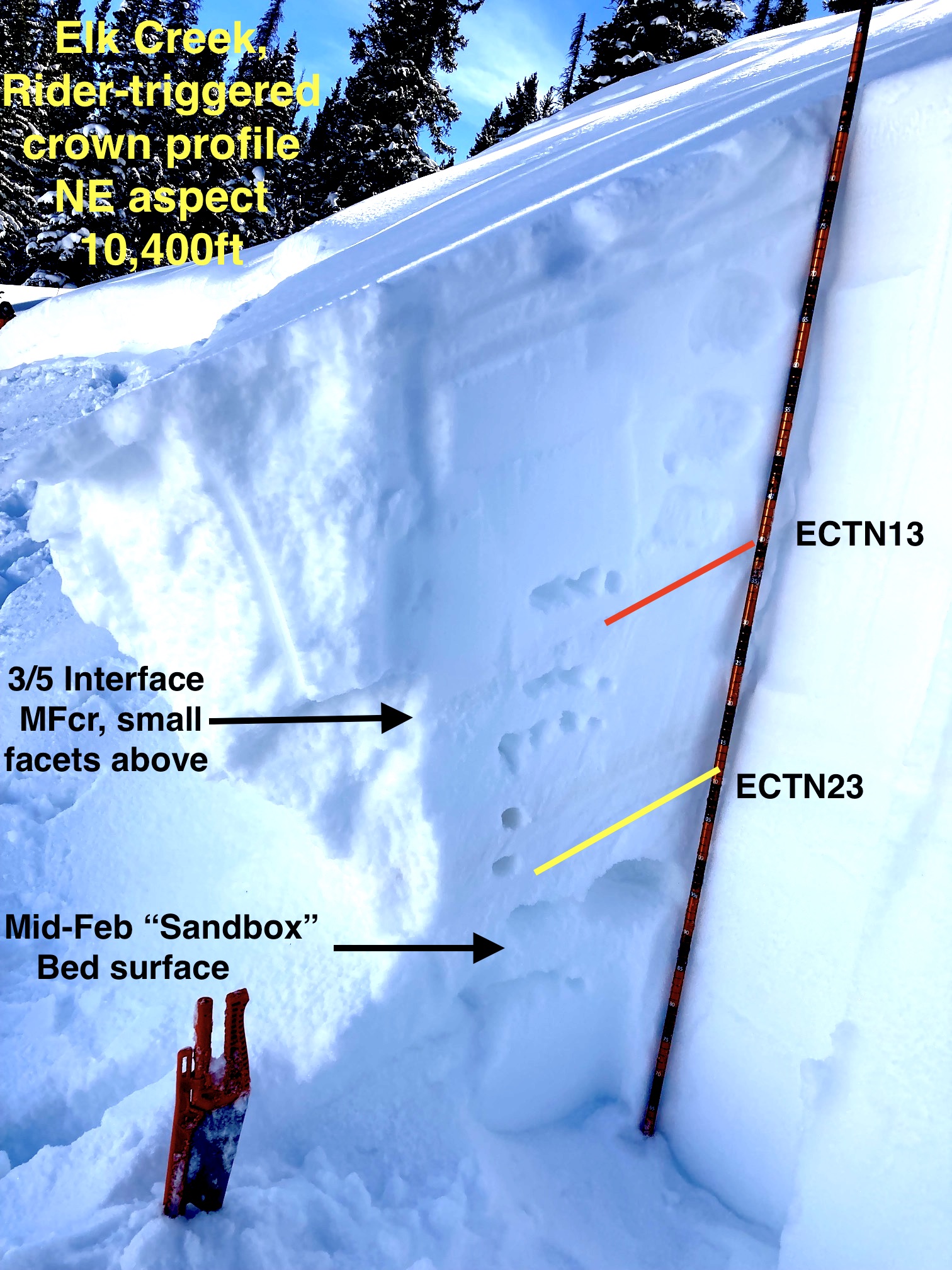
Snowpack: At the site of a recent large rider-triggered avalanche, the crown was 2-3 ft deep, it propagated around 150 ft wide and ran around 400 ft to the creek. A few inches of overnight snow are sitting on a thin melt-freeze crust from Saturday’s warming. It appears the avalanche failed on the 3/5 interface and stepped down to the Mid-February “sandbox” layer. The 3/5 interface is a soft melt-freeze crust with pit tests failing on small facets above the crust. A 50 cm soft slab(Fist to 4 Finger hard) is resting on this interface at this location. Failure occurred on this layer first, before the deeper, mid-February layer buried around 80 cm. While part of this slope likely avalanched early during the late February cycle, the slab/weak layer combo was obviously left mostly intact with the 3/5 interface forming during a dry spell before the last couple of storms.


[/gravityforms]
5492